Same state, different city: Where locals and out-of-staters choose to move

Carbonatix Pre-Player Loader

Audio By Carbonatix

Same state, different city: Where locals and out-of-staters choose to move

Do state residents know something that newcomers don’t? Or do short-distance movers simply prefer different home bases compared with inbound newcomers?

Whatever the reason, there’s a clear divide in many states between the most desirable moving destination city. And the difference hinges on the mover’s current location.

Using searches from moveBuddha’s moving cost calculator, moveBuddha looked at 120,000 potential movers’ searches made between April 1, 2025, and March 31, 2026 to see where state residents vs. out-of-state movers were looking to land.

Within states, movers often prioritize practicalities like price and jobs, according to the research. But when a move crosses state lines, perceived desirability and lifestyle often matter more.

Key Takeaways

  • Outsiders and locals rarely agree on the top move-to city in their state. In-staters favor practicality, while newcomers favor desirability.
  • Out-of-staters are far more decisive about where they want to go. Top destinations for interstate relocation see dramatically higher interest, like Wake Forest, North Carolina, and Conway, South Carolina, with in-to-out ratios over 4.5.
  • Dream towns dominate the interstate list. Think Lewes, Delaware, Mesquite, Nevada, Coeur d’Alene, Idaho, Rancho Mirage, California, and Kingman, Arizona, all are ranked high despite having small populations. Lifestyle and retirement value are driving these searches, not job markets.
  • In-staters are upgrading, not escaping. Ocala, Florida, wins among intrastate movers, drawing 3.74 Floridians to this affordable, mid-sized city away from the coast. Georgetown, Texas, Reno, Nevada, Spokane, Washington, and Asheville, North Carolina, also lead the intrastate list offering livability and lower costs without starting over.

One State: Two Very Different Top Destinations

Lansing or Holland, Michigan? Beaverton or Bend, Oregon?

State residents have different priorities from those moving in, suggesting that residents and outsiders aren’t thinking the same about their moves. For the most part, newcomers are seeking cultural appeal, like Holland’s art walks and shoreside sunsets or Bend’s single-track biking and brewery vibes.

To see those different priorities in focus, moveBuddha looked at the 20 states that produced a qualifying top destination.

The result is a map that tells two stories: one of familiarity and one of outside perception.

Out-of-Staters Are More Decisive

In 17 of the 20 states (85%), the top interstate destination has a higher inbound-to-outbound ratio than the top intrastate destination. And interstate ratios average 2.47 new inbound moves for every outbound move, while among intrastate winners, the average is 1.53 (roughly 38% lower).
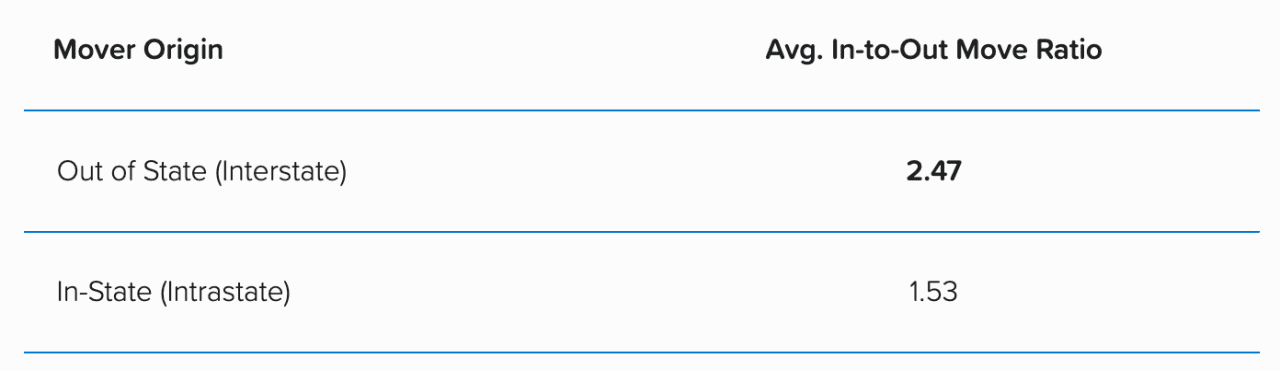
Table showing the average in-to-out move ratio of movers from inter or intrastate.
moveBuddha


Out of state movers are fueling some of the nation’s most popular spots in the Carolinas, with Wake Forest (4.68), and Conway (4.57), seeing the highest overall interstate interest. Both rate over 30% more interest from out-of-staters, compared to third-place Foley, Alabama (3.48).

Outsider confidence is highest in South Carolina, where outsiders favor Conway 278% higher than Myrtle Beach, the preference among in-staters (with a much more modest move ratio of 1.21).

Once an unsung inland cousin 20 miles northwest, today, Conway comes with picture-perfect charm, proximity to Coastal Carolina University, and not-too-far Myrtle Beach sunrises. It’s been the overall most desired move destination in South Carolina this year, but for some reason, locals aren’t paying as much attention.

In North Carolina, the spread is almost as stark. Newcomers go to Wake Forest at a rate 230% higher than how often longstanding Tar Heels are heading to Asheville, despite the small city’s surging move interest in 2026.

Together, Wake Forest and Conway average an interstate move ratio of 4.63, while the other interstate destinations in the table average about 2.23. That means that Carolina’s leaders are, on average, seeing more than four long-haul moving trucks turning onto their streets for every one leaving.
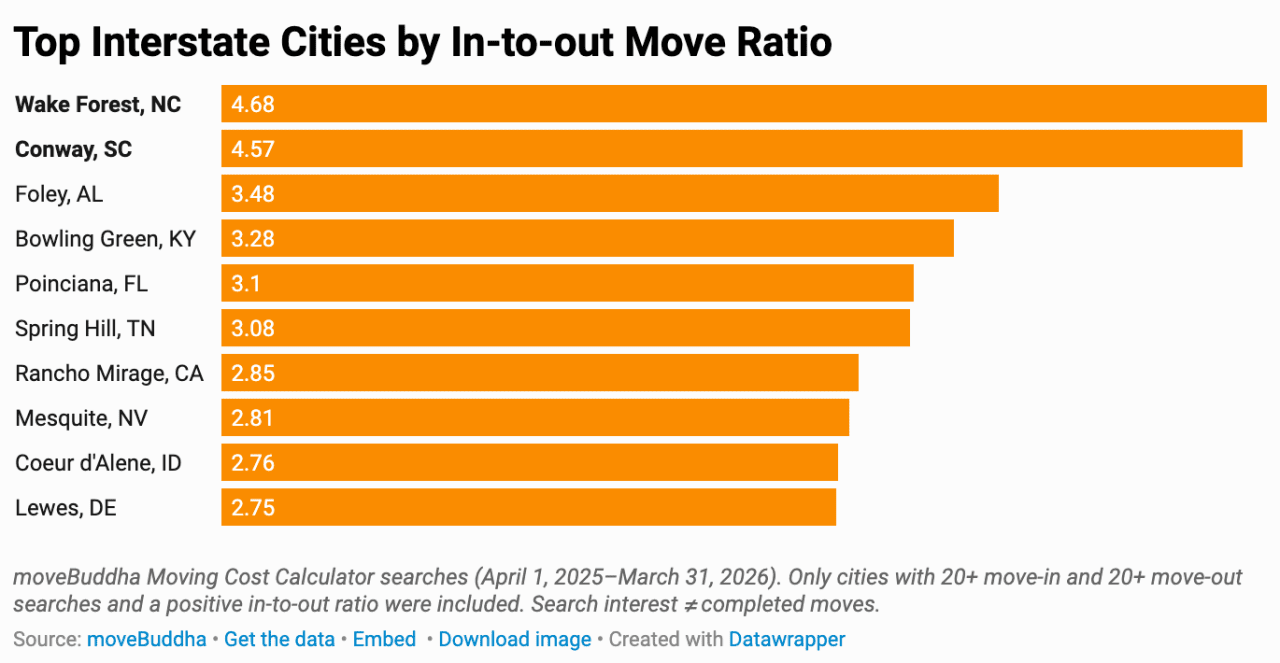
A data bar chart showing the top interstate cities by in-to-out move ratio. Wake Forest, NC ranks at #1 with 4.68%.
moveBuddha


Lifestyle Choices Dominate Out-of-State Moves

With an average population of about 48,500, the interstate darlings of Wake Forest, Conway, Foley, Bozeman, Montana, Bend, Coeur d’Alene, and Lewes show that Americans are perfectly happy saying adios to traffic jams, no matter where they’re moving.

From beachfront Lewes to the nearly-coastal Foley or Conway, and ski towns Bend and Coeur d’Alene, out-of-staters are heading to places that are small but cool.

There are some outliers: Wake Forest’s suburban-chic reputation outpaces in-staters’ artsier choice, Asheville. And Nashville’s southside suburb, Spring Hill, Tennessee, has a much stronger inbound skew (about 103% higher) among interstate movers than scenic, outdoorsy Chattanooga, where locals plan to move most.

However, because our calculator is most often used for interstate moves, the signal for these longer-distance treks is strong, and it’s clear that interstate winners are overwhelmingly those with retirement appeal, outdoor recreation, and remote work cachet.

Locals are Flocking to Familiar Cities with Everyday Appeal

Ocala wins intrastate moving rates with a move ratio of 3.74. It’s about as far as you can get from dipping your toes in the surf anywhere in Florida. And it’s about 80 miles from the nearest large city, Orlando. So, why are residents gaga over this sprawling, horsey town with decidedly low-key ambiance?

For one, the cost of living is 19% lower than elsewhere in Florida.

Even younger in-staters are moving to mid-sized cities with room to grow.
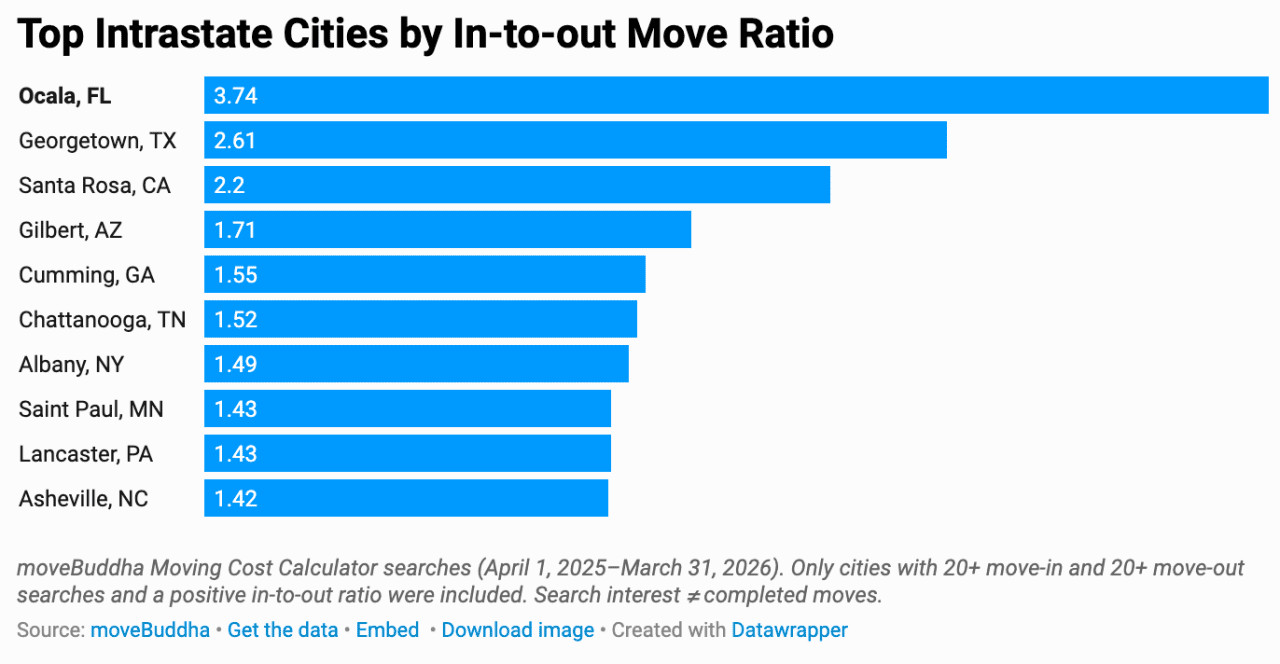
A data bar chart showing the top intrastate cities by in-to-out move ration. Ocala, FL ranks at the top with 3.74%.
moveBuddha


In Georgetown, bright lights and higher costs lie beyond the beltway. Houses here average 16% less than in Austin.

For Gilbert, Arizona, the same long commute is justified by the newer, bigger homes. In Chattanooga, paddling on Lookout Creek beckons. In St. Paul, Minnesota, and Asheville, cultural offerings reinforce the pattern: In-state movers are nudging their way toward (relatively) affordable and more livable options.

They’ll stay closer to state hubs, to family, and to networks. But they’ll opt for more house, more space, and better lifestyles in practical ways, without the need to box up everything and start fresh.

In-State and Out-of-State Movers Show Their Style

Overall, state insiders are fine-tuning their lifestyles and optimizing bank accounts without uprooting everything. They’re willing to look into affordable mid-size sleeper cities. Mountain towns off the main highway. Suburbs further afield.

But for those who are heading to an entirely new state, the risks are real. Interstate movers are acting like they have more to lose, and overwhelmingly heading to marquee cities, marching in the opposite direction from in-staters.

Maybe, if everything else goes wrong, the beach, the snow, the Research Triangle’s job market — those will remain.

Or maybe not: In a few years, they might just be packing up with their in-state compatriots and fine-tuning their own lifestyles.

Methodology

For the study, moveBuddha analyzed 120,000 move searches made through moveBuddha’s Moving Cost Calculator between April 1, 2025, and March 31, 2026.

To compare how moving preferences differ by origin, the researchers separated searches into two groups:

  • Intrastate moves: searches from people moving within the same state
  • Interstate moves: searches from people moving into a state from somewhere else

To improve reliability, the researchers only included cities with at least 20 move-in searches and 20 move-out searches. They also limited the analysis to cities with a positive inbound-to-outbound ratio, meaning more people were searching to move in than to move out. After applying those filters, the dataset included:

  • 1,097 cities with sufficient interstate move-search volume
  • 207 cities with sufficient intrastate move-search volume

From this moveBuddha was able to identify the top interstate city for relocation in 47 states and top intrastate city for relocation in 20 states.

For this report, the researchers focus on the twenty states with both a top interstate and intrastate city for relocation.

Because moveBuddha’s Moving Cost Calculator is most often used for longer-distance planning, interstate searches represent the more robust portion of the dataset. Additionally, this analysis measures search interest, not completed moves. Search behavior is an early indicator of relocation demand, but it should not be read as a final count of households that moved.
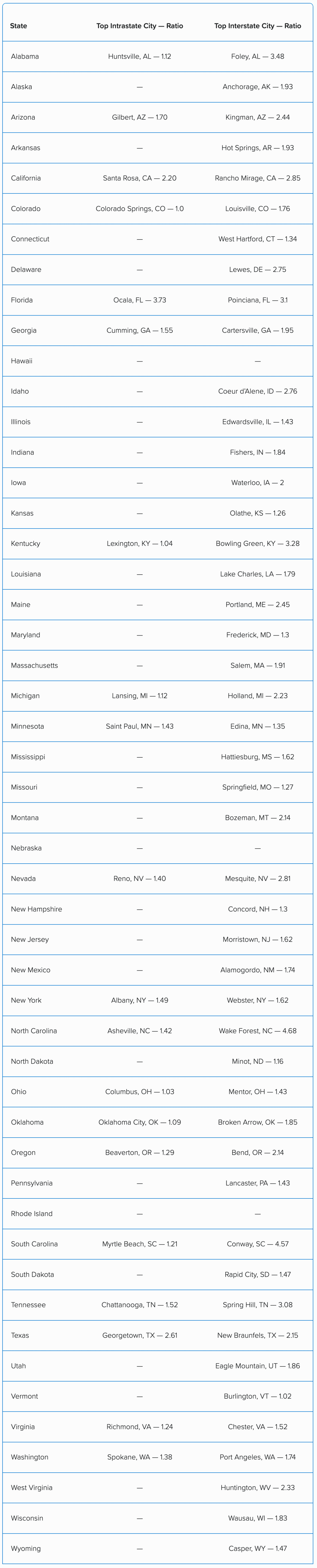
Table listing all states and their top intrastate and interstate city ratio values.
moveBuddha


This story was produced by moveBuddha and reviewed and distributed by Stacker.

 

Salem News Channel Today

Sponsored Links


September 26 - Phoenix, AZ
Scottsdale Center for the Performing Arts


November 2 - Detroit, MI
Zion Christian Church in Troy


October 6 - Los Angeles, CA
Pasadena Convention Center


November 5 - San Antonio, TX
Norris Centers – The Grand Red Oak Ballroom


October 8 - Sacramento, CA
William Jessup University


November 7 - Tampa, FL
The Palladium at St. Pete College


October 22 - Minneapolis, MN
Crowne Plaza AiRE


November 15 - San Francisco, CA
Fremont Marriott Silicon Valley


October 23 - Philadelphia, PA
Green Valley Country Club


November 16 - Denver, CO
CU South Denver - Formerly Wildlife Experience


November 2 - Chicago, IL
Chicago Westin Northwest in Itasca


November 21 - Cleveland, OH
Holiday Inn Rockside in Independence


Salem Radio Network Speakers

Larry Elder is an American lawyer, writer, and radio and television personality who calls himself the "Sage of South Central" a district of Los Angeles, Larry says his philosophy is to entertain, inform, provoke and to hopefully uplift. His calling card is "we have a country to save" and to him this means returning to the bedrock Constitutional principles of limited government and maximum personal responsibility. Elder's iconoclastic wit and intellectual agility makes him a particularly attractive voice in a nation that seems weary of traditional racial dialogue.” – Los Angeles Times.

Mike Gallagher Mike Gallagher began his broadcasting career in 1978 in Dayton, Ohio. Today, he is one of the most listened-to talk radio show hosts in America, recently having been ranked in the Talkers Magazine “Heavy Hundred” list – the 100 most important talk radio hosts in America. Prior to being launched into national syndication in 1998, Mike hosted the morning show on WABC-AM in New York City. Today, Talkers Magazine reports that his show is heard by over 3.75 million weekly listeners. Besides his radio work, Mike is seen on Fox News Channel as an on-air contributor, frequently appearing on the cable news giant.

Hugh Hewitt is one of the nation’s leading bloggers and a genuine media revolutionary. He brings that expertise, his wit and what The New Yorker magazine calls his “amiable but relentless manner” to his nationally syndicated show each day.

When Dr. Sebastian Gorka was growing up, he listened to talk radio under his pillow with a transistor radio, dreaming that one day he would be behind the microphone. Beginning New Year’s Day 2019, he got his wish. Gorka now hosts America First every weekday afternoon 3 to 6pm ET. Gorka’s unique story works well on the radio. He is national security analyst for the Fox News Channel and author of two books: "Why We Fight" and "Defeating Jihad." His latest book releasing this fall is “War For America’s Soul.” He is uniquely qualified to fight the culture war and stand up for what is great about America, his adopted home country.

Broadcasting from his home station of KRLA in Los Angeles, the Dennis Prager Show is heard across the country. Everything in life – from politics to religion to relationships – is grist for Dennis’ mill. If it’s interesting, if it affects your life, then Dennis will be talking about it – with passion, humor, insight and wisdom.

Sean Hannity is a conservative radio and television host, and one of the original primetime hosts on the Fox News Channel, where he has appeared since 1996. Sean Hannity began his radio career at a college station in California, before moving on to markets in the Southeast and New York. Today, he’s one of the most listened to on-air voices. Hannity’s radio program went into national syndication on September 10, 2001, and airs on more than 500 stations. Talkers Magazine estimates Hannity’s weekly radio audience at 13.5 million. In 1996 he was hired as one of the original hosts on Fox News Channel. As host of several popular Fox programs, Hannity has become the highest-paid news anchor on television.

Michelle Malkin is a mother, wife, blogger, conservative syndicated columnist, longtime cable TV news commentator, and best-selling author of six books. She started her newspaper journalism career at the Los Angeles Daily News in 1992, moved to the Seattle Times in 1995, and has been penning nationally syndicated newspaper columns for Creators Syndicate since 1999. She is founder of conservative Internet start-ups Hot Air and Twitchy.com. Malkin has received numerous awards for her investigative journalism, including the Council on Governmental Ethics Laws (COGEL) national award for outstanding service for the cause of governmental ethics and leadership (1998), the Reed Irvine Accuracy in Media Award for Investigative Journalism (2006), the Heritage Foundation and Franklin Center for Government & Public Integrity's Breitbart Award for Excellence in Journalism (2013), the Center for Immigration Studies' Eugene Katz Award for Excellence in the Coverage of Immigration Award (2016), and the Manhattan Film Festival's Film Heals Award (2018). Married for 26 years and the mother of two teenage children, she lives with her family in Colorado. Follow her at michellemalkin.com. (Photo reprinted with kind permission from Peter Duke Photography.)

Sponsored by:

Same state, different city: Where locals and out-of-staters choose to move

Carbonatix Pre-Player Loader

Audio By Carbonatix

Same state, different city: Where locals and out-of-staters choose to move

Do state residents know something that newcomers don’t? Or do short-distance movers simply prefer different home bases compared with inbound newcomers?

Whatever the reason, there’s a clear divide in many states between the most desirable moving destination city. And the difference hinges on the mover’s current location.

Using searches from moveBuddha’s moving cost calculator, moveBuddha looked at 120,000 potential movers’ searches made between April 1, 2025, and March 31, 2026 to see where state residents vs. out-of-state movers were looking to land.

Within states, movers often prioritize practicalities like price and jobs, according to the research. But when a move crosses state lines, perceived desirability and lifestyle often matter more.

Key Takeaways

  • Outsiders and locals rarely agree on the top move-to city in their state. In-staters favor practicality, while newcomers favor desirability.
  • Out-of-staters are far more decisive about where they want to go. Top destinations for interstate relocation see dramatically higher interest, like Wake Forest, North Carolina, and Conway, South Carolina, with in-to-out ratios over 4.5.
  • Dream towns dominate the interstate list. Think Lewes, Delaware, Mesquite, Nevada, Coeur d’Alene, Idaho, Rancho Mirage, California, and Kingman, Arizona, all are ranked high despite having small populations. Lifestyle and retirement value are driving these searches, not job markets.
  • In-staters are upgrading, not escaping. Ocala, Florida, wins among intrastate movers, drawing 3.74 Floridians to this affordable, mid-sized city away from the coast. Georgetown, Texas, Reno, Nevada, Spokane, Washington, and Asheville, North Carolina, also lead the intrastate list offering livability and lower costs without starting over.

One State: Two Very Different Top Destinations

Lansing or Holland, Michigan? Beaverton or Bend, Oregon?

State residents have different priorities from those moving in, suggesting that residents and outsiders aren’t thinking the same about their moves. For the most part, newcomers are seeking cultural appeal, like Holland’s art walks and shoreside sunsets or Bend’s single-track biking and brewery vibes.

To see those different priorities in focus, moveBuddha looked at the 20 states that produced a qualifying top destination.

The result is a map that tells two stories: one of familiarity and one of outside perception.

Out-of-Staters Are More Decisive

In 17 of the 20 states (85%), the top interstate destination has a higher inbound-to-outbound ratio than the top intrastate destination. And interstate ratios average 2.47 new inbound moves for every outbound move, while among intrastate winners, the average is 1.53 (roughly 38% lower).

Table showing the average in-to-out move ratio of movers from inter or intrastate.
moveBuddha


Out of state movers are fueling some of the nation’s most popular spots in the Carolinas, with Wake Forest (4.68), and Conway (4.57), seeing the highest overall interstate interest. Both rate over 30% more interest from out-of-staters, compared to third-place Foley, Alabama (3.48).

Outsider confidence is highest in South Carolina, where outsiders favor Conway 278% higher than Myrtle Beach, the preference among in-staters (with a much more modest move ratio of 1.21).

Once an unsung inland cousin 20 miles northwest, today, Conway comes with picture-perfect charm, proximity to Coastal Carolina University, and not-too-far Myrtle Beach sunrises. It’s been the overall most desired move destination in South Carolina this year, but for some reason, locals aren’t paying as much attention.

In North Carolina, the spread is almost as stark. Newcomers go to Wake Forest at a rate 230% higher than how often longstanding Tar Heels are heading to Asheville, despite the small city’s surging move interest in 2026.

Together, Wake Forest and Conway average an interstate move ratio of 4.63, while the other interstate destinations in the table average about 2.23. That means that Carolina’s leaders are, on average, seeing more than four long-haul moving trucks turning onto their streets for every one leaving.

A data bar chart showing the top interstate cities by in-to-out move ratio. Wake Forest, NC ranks at #1 with 4.68%.
moveBuddha


Lifestyle Choices Dominate Out-of-State Moves

With an average population of about 48,500, the interstate darlings of Wake Forest, Conway, Foley, Bozeman, Montana, Bend, Coeur d’Alene, and Lewes show that Americans are perfectly happy saying adios to traffic jams, no matter where they’re moving.

From beachfront Lewes to the nearly-coastal Foley or Conway, and ski towns Bend and Coeur d’Alene, out-of-staters are heading to places that are small but cool.

There are some outliers: Wake Forest’s suburban-chic reputation outpaces in-staters’ artsier choice, Asheville. And Nashville’s southside suburb, Spring Hill, Tennessee, has a much stronger inbound skew (about 103% higher) among interstate movers than scenic, outdoorsy Chattanooga, where locals plan to move most.

However, because our calculator is most often used for interstate moves, the signal for these longer-distance treks is strong, and it’s clear that interstate winners are overwhelmingly those with retirement appeal, outdoor recreation, and remote work cachet.

Locals are Flocking to Familiar Cities with Everyday Appeal

Ocala wins intrastate moving rates with a move ratio of 3.74. It’s about as far as you can get from dipping your toes in the surf anywhere in Florida. And it’s about 80 miles from the nearest large city, Orlando. So, why are residents gaga over this sprawling, horsey town with decidedly low-key ambiance?

For one, the cost of living is 19% lower than elsewhere in Florida.

Even younger in-staters are moving to mid-sized cities with room to grow.

A data bar chart showing the top intrastate cities by in-to-out move ration. Ocala, FL ranks at the top with 3.74%.
moveBuddha


In Georgetown, bright lights and higher costs lie beyond the beltway. Houses here average 16% less than in Austin.

For Gilbert, Arizona, the same long commute is justified by the newer, bigger homes. In Chattanooga, paddling on Lookout Creek beckons. In St. Paul, Minnesota, and Asheville, cultural offerings reinforce the pattern: In-state movers are nudging their way toward (relatively) affordable and more livable options.

They’ll stay closer to state hubs, to family, and to networks. But they’ll opt for more house, more space, and better lifestyles in practical ways, without the need to box up everything and start fresh.

In-State and Out-of-State Movers Show Their Style

Overall, state insiders are fine-tuning their lifestyles and optimizing bank accounts without uprooting everything. They’re willing to look into affordable mid-size sleeper cities. Mountain towns off the main highway. Suburbs further afield.

But for those who are heading to an entirely new state, the risks are real. Interstate movers are acting like they have more to lose, and overwhelmingly heading to marquee cities, marching in the opposite direction from in-staters.

Maybe, if everything else goes wrong, the beach, the snow, the Research Triangle’s job market — those will remain.

Or maybe not: In a few years, they might just be packing up with their in-state compatriots and fine-tuning their own lifestyles.

Methodology

For the study, moveBuddha analyzed 120,000 move searches made through moveBuddha’s Moving Cost Calculator between April 1, 2025, and March 31, 2026.

To compare how moving preferences differ by origin, the researchers separated searches into two groups:

  • Intrastate moves: searches from people moving within the same state
  • Interstate moves: searches from people moving into a state from somewhere else

To improve reliability, the researchers only included cities with at least 20 move-in searches and 20 move-out searches. They also limited the analysis to cities with a positive inbound-to-outbound ratio, meaning more people were searching to move in than to move out. After applying those filters, the dataset included:

  • 1,097 cities with sufficient interstate move-search volume
  • 207 cities with sufficient intrastate move-search volume

From this moveBuddha was able to identify the top interstate city for relocation in 47 states and top intrastate city for relocation in 20 states.

For this report, the researchers focus on the twenty states with both a top interstate and intrastate city for relocation.

Because moveBuddha’s Moving Cost Calculator is most often used for longer-distance planning, interstate searches represent the more robust portion of the dataset. Additionally, this analysis measures search interest, not completed moves. Search behavior is an early indicator of relocation demand, but it should not be read as a final count of households that moved.

Table listing all states and their top intrastate and interstate city ratio values.
moveBuddha


This story was produced by moveBuddha and reviewed and distributed by Stacker.

 

Salem News Channel Today

Sponsored Links

On Air & Up Next

See the Full Program Guide