Survey finds 78% of dads are parenting more openly than their own fathers did

Carbonatix Pre-Player Loader

Audio By Carbonatix

Survey finds 78% of dads are parenting more openly than their own fathers did

Fathers pass down so much more than just genes or last names. How a man's father handled stress and vulnerability often became the default behavior his children absorbed. For a lot of men, that meant learning to keep their feelings to themselves.

Men have historically been less likely than women to seek mental health support. Grow Therapy's Caregivers Report confirms that women caregivers are consistently more likely than men to seek out mental health support.

Grow Therapy surveyed over 1,500 fathers of children under 18 to understand how today's dads are approaching emotional openness and mental health at home. Seventy-eight percent say they approach those conversations more openly than the household they grew up in.

A separate Grow Therapy survey of 752 parents and children under 18 conducted from Sept. 29 to Oct. 3, 2025 focused on parents’ understanding of their children’s mental health. That survey also found that fathers were nearly identical to mothers in their confidence in recognizing signs of mental health struggles in their children. 41% of fathers said they feel very prepared and know what signs to look for, compared to 40% of mothers.

What this new survey of fathers shows is that wanting to parent differently and knowing how to do it in the moment aren't always the same thing, and there are specific places where old habits still hold.

Key takeaways

  • 78% of fathers say they approach emotional and mental health conversations with their children more openly than in the household they grew up in.
  • 70% actively encourage their children to come to them with emotional or mental health problems, but only 52% say they proactively start those conversations and feel prepared to lead them.
  • Only 35% of fathers selected “express vulnerability openly” as an approach they use or plan to use in parenting, suggesting that many fathers may still be navigating what emotional openness looks like in practice.
  • Only 20% would tell their children if they’ve attended therapy, even though 38% want professional support for their child and 35% want it for themselves.

Today's fathers are having the mental health conversations their own dads largely didn't

Nearly 4 in 5 fathers describe their approach to emotional and mental health conversations with their children as more expressive than what they experienced growing up. That comparison is often shaped by early models of masculinity, caregiving and emotional expression: 82% said a father or stepfather was their primary male adult figure in childhood.

Most fathers in this survey weren't raised in emotionally closed homes. Three-quarters of those who had a primary male adult in childhood felt at least somewhat comfortable bringing emotional or mental health problems to that person. And 70% of all fathers actively encourage their own children to come to them with those same conversations.

The 23% who felt uncomfortable opening up to their own father figure are showing up differently for their households. Of those, 51% said their approach is much more expressive and emotionally open than the way they grew up. Fathers who felt less comfortable opening up to their own male figures and fathers who felt comfortable are both choosing to go further, just from different starting points. The data doesn't rank those motivations, but both count.

The fathers who had the toughest time opening up to their own dads are actually the most likely to parent differently. Eighty-eight percent of those who felt very uncomfortable opening up to their own primary male adult figure growing up now describe themselves as more emotionally expressive with their own children, compared to 77% of fathers who had a very comfortable relationship with their own dad.

Avoiding these conversations is now a fringe position, with fewer than 2% saying they prefer to.
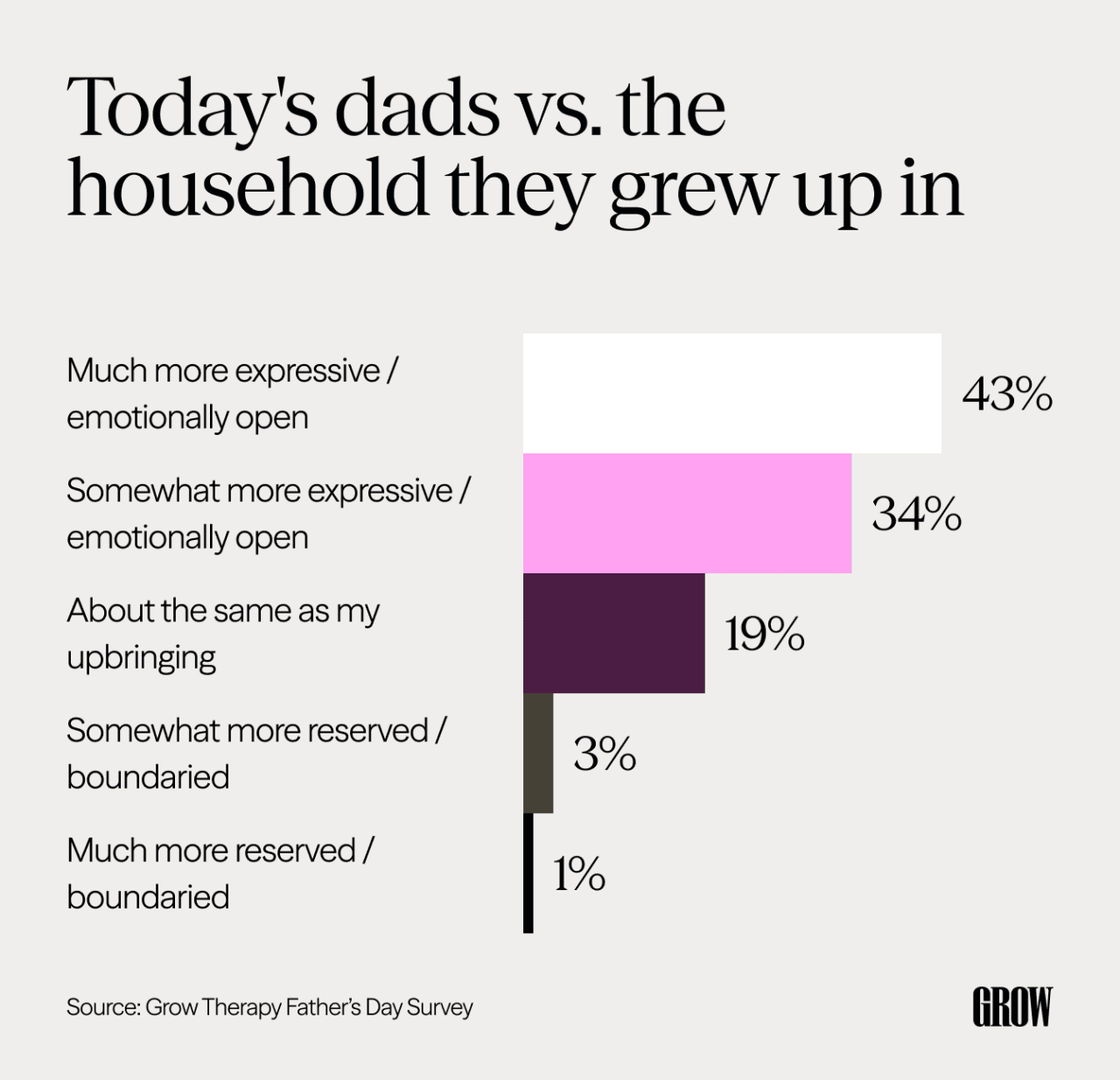
A chart showing survey results of how much dads feel more expressive than the households they grew up in.
Grow Therapy


Most dads are starting the conversation, but modeling is the harder step

Starting a conversation about emotions and actually showing emotional vulnerability aren’t the same skill. Showing vulnerability takes practice most adults never got. Few grew up with adults around who modeled it. Data suggests fathers are further along on one than the other.

More than half (52%) of fathers say they actively start mental health and emotional conversations with their children and feel prepared to lead them. Many others are engaged but still building confidence: 26% say they try to start these conversations but sometimes feel like they are winging it or unsure of the right words, while 15% say they do not proactively start conversations but make themselves available to listen when their child comes to them.

Only 35% of fathers selected “express vulnerability openly” as an approach they use or plan to use in parenting. Showing vulnerability with children can feel like walking a tightrope. Too little, and your child may not see emotional openness modeled. Too much, and your child may take on your stress as their own. Many fathers are still finding that balance.
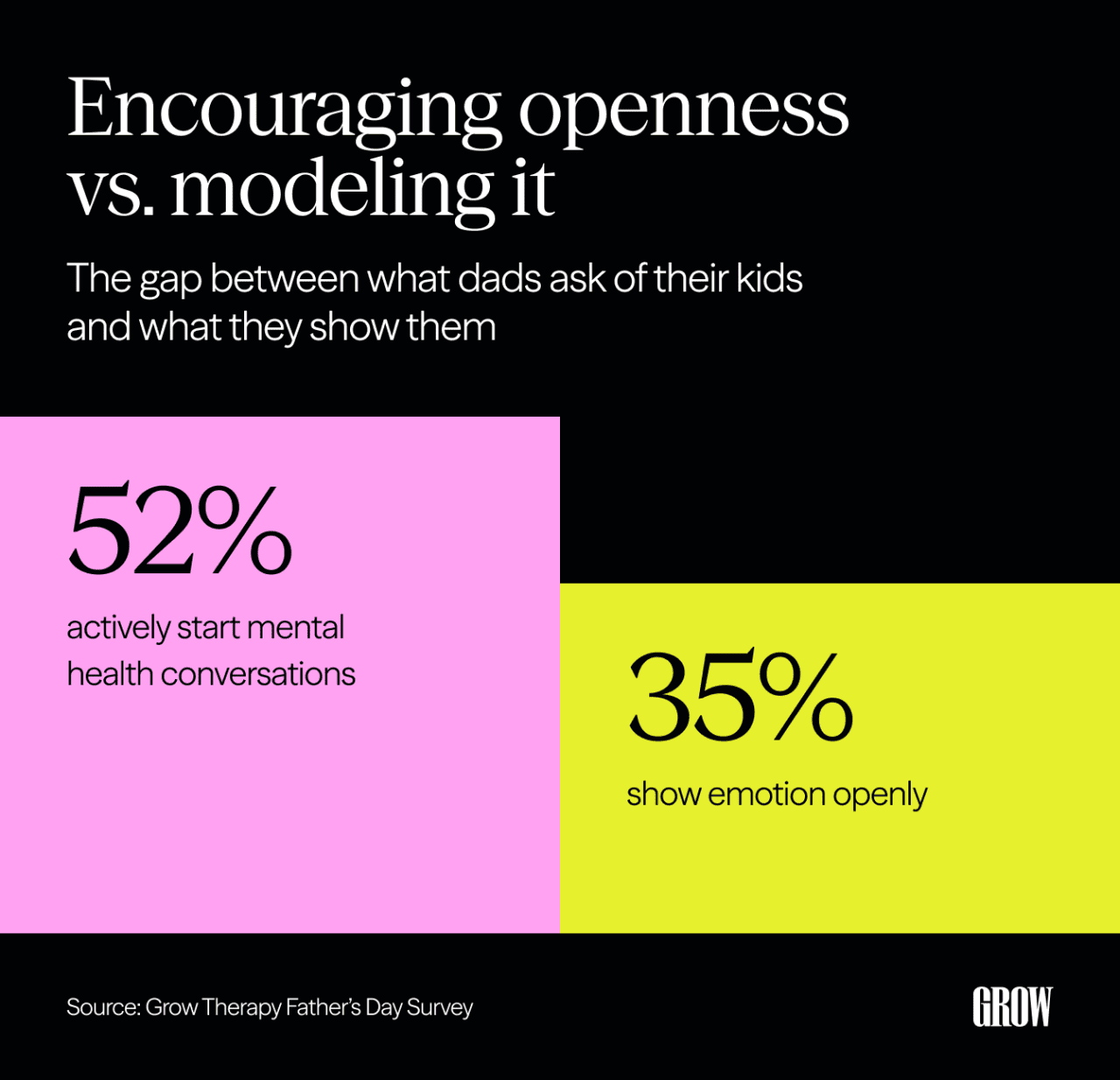
A survey showing percentage results of how dads encourage openness of their kids than modeling it to them.
Grow Therapy


Dads are warming up to therapy, but talking about it at home is the next frontier

Most fathers have made real progress with emotional openness. But therapy is the part of that conversation that still feels personal in a different way.

Only 31% of fathers talk to their children about therapy as a normal part of life, and only 20% say they would tell their children if they've attended therapy. Those numbers are low, but they're not surprising. For fathers who didn't grow up seeing it modeled, knowing how to introduce it naturally at home is its own learning curve.

But that doesn’t reflect a lack of interest: 38% said professional support for their child would be most helpful to them right now, and 35% said the same for themselves. The willingness to seek help and talk about it is just arriving on different timelines.

Fathers also have a desire for more support, with 37% having said books, podcasts or content made specifically for fathers would be helpful. Thirty-one percent wanted a community of other fathers navigating similar situations, and 28% wanted specific language or scripts for starting conversations.

Only 20% feel adequately equipped already. Research consistently shows that therapy stigma remains a barrier for men. And this data suggests it hasn’t fully lifted even among fathers who already value mental health care.
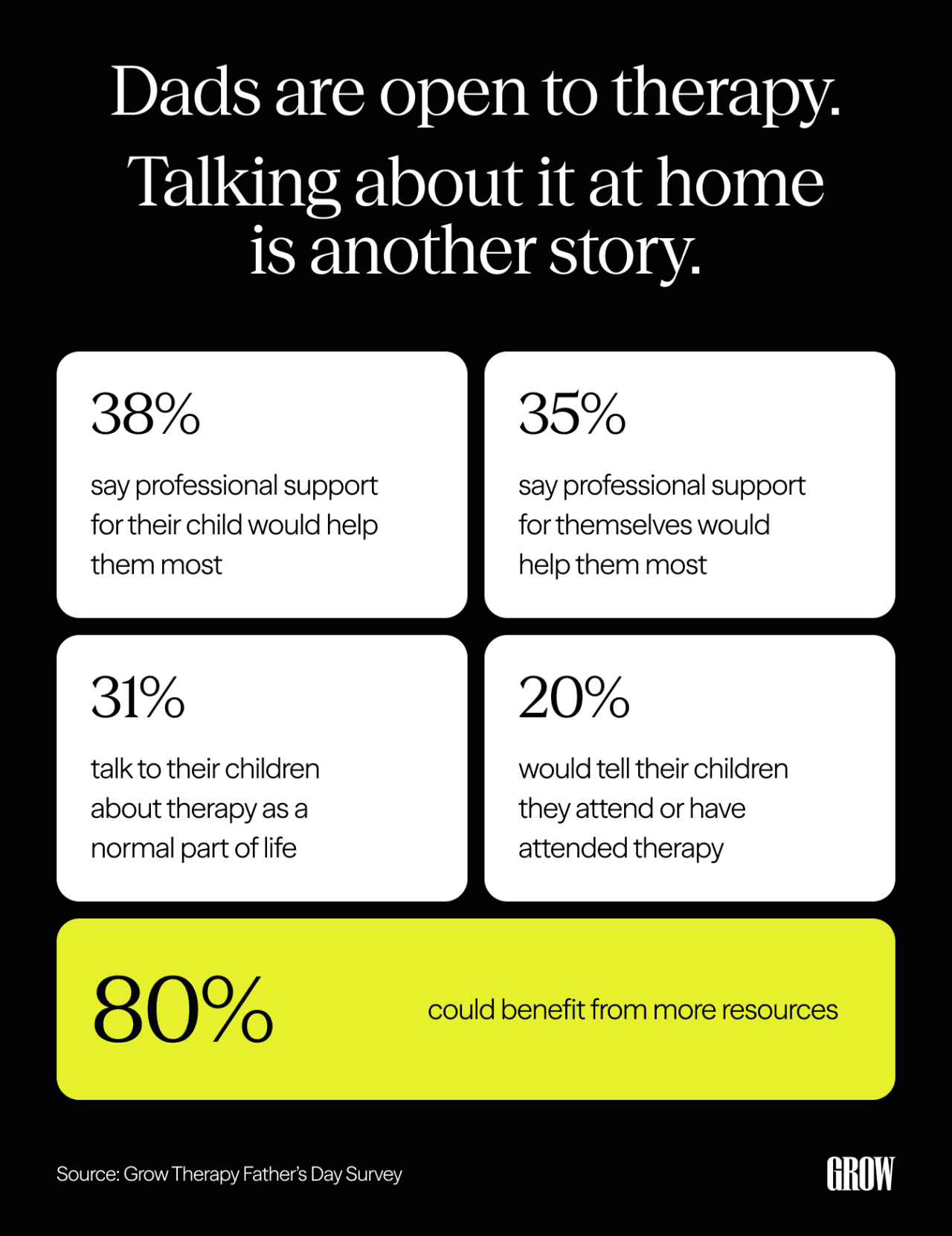
A survey showing percentage results of how much dads are open to therapy than just talking about it at home.
Grow Therapy


What this means for the next generation

A 2024 report from the U.S. Surgeon General on the mental health of parents confirms that a parent's own emotional well-being directly shapes the environment children grow up in. Fathers in this survey seem to understand that connection and are working toward it.

Many are further along than their own fathers were, and some are still figuring out what emotional openness actually looks like in their day-to-day lives.

Methodology

The survey was conducted by Centiment for Grow Therapy, and fielded from May 11–15, 2026. Results are based on 1,534 completed surveys. The framing of these findings was informed by insights from a father on the Grow Therapy research team. Respondents were screened to be U.S. residents, over 18 years of age, and a father of at least one child aged 18 or younger. Data is unweighted, and the margin of error is approximately +/-3 % for the overall sample with a 95% confidence level.

This story was produced by Grow Therapy and reviewed and distributed by Stacker.

 

Salem News Channel Today

Sponsored Links


September 26 - Phoenix, AZ
Scottsdale Center for the Performing Arts


November 2 - Detroit, MI
Zion Christian Church in Troy


October 6 - Los Angeles, CA
Pasadena Convention Center


November 5 - San Antonio, TX
Norris Centers – The Grand Red Oak Ballroom


October 8 - Sacramento, CA
William Jessup University


November 7 - Tampa, FL
The Palladium at St. Pete College


October 22 - Minneapolis, MN
Crowne Plaza AiRE


November 15 - San Francisco, CA
Fremont Marriott Silicon Valley


October 23 - Philadelphia, PA
Green Valley Country Club


November 16 - Denver, CO
CU South Denver - Formerly Wildlife Experience


November 2 - Chicago, IL
Chicago Westin Northwest in Itasca


November 21 - Cleveland, OH
Holiday Inn Rockside in Independence


Salem Radio Network Speakers

Larry Elder is an American lawyer, writer, and radio and television personality who calls himself the "Sage of South Central" a district of Los Angeles, Larry says his philosophy is to entertain, inform, provoke and to hopefully uplift. His calling card is "we have a country to save" and to him this means returning to the bedrock Constitutional principles of limited government and maximum personal responsibility. Elder's iconoclastic wit and intellectual agility makes him a particularly attractive voice in a nation that seems weary of traditional racial dialogue.” – Los Angeles Times.

Mike Gallagher Mike Gallagher began his broadcasting career in 1978 in Dayton, Ohio. Today, he is one of the most listened-to talk radio show hosts in America, recently having been ranked in the Talkers Magazine “Heavy Hundred” list – the 100 most important talk radio hosts in America. Prior to being launched into national syndication in 1998, Mike hosted the morning show on WABC-AM in New York City. Today, Talkers Magazine reports that his show is heard by over 3.75 million weekly listeners. Besides his radio work, Mike is seen on Fox News Channel as an on-air contributor, frequently appearing on the cable news giant.

Hugh Hewitt is one of the nation’s leading bloggers and a genuine media revolutionary. He brings that expertise, his wit and what The New Yorker magazine calls his “amiable but relentless manner” to his nationally syndicated show each day.

When Dr. Sebastian Gorka was growing up, he listened to talk radio under his pillow with a transistor radio, dreaming that one day he would be behind the microphone. Beginning New Year’s Day 2019, he got his wish. Gorka now hosts America First every weekday afternoon 3 to 6pm ET. Gorka’s unique story works well on the radio. He is national security analyst for the Fox News Channel and author of two books: "Why We Fight" and "Defeating Jihad." His latest book releasing this fall is “War For America’s Soul.” He is uniquely qualified to fight the culture war and stand up for what is great about America, his adopted home country.

Broadcasting from his home station of KRLA in Los Angeles, the Dennis Prager Show is heard across the country. Everything in life – from politics to religion to relationships – is grist for Dennis’ mill. If it’s interesting, if it affects your life, then Dennis will be talking about it – with passion, humor, insight and wisdom.

Sean Hannity is a conservative radio and television host, and one of the original primetime hosts on the Fox News Channel, where he has appeared since 1996. Sean Hannity began his radio career at a college station in California, before moving on to markets in the Southeast and New York. Today, he’s one of the most listened to on-air voices. Hannity’s radio program went into national syndication on September 10, 2001, and airs on more than 500 stations. Talkers Magazine estimates Hannity’s weekly radio audience at 13.5 million. In 1996 he was hired as one of the original hosts on Fox News Channel. As host of several popular Fox programs, Hannity has become the highest-paid news anchor on television.

Michelle Malkin is a mother, wife, blogger, conservative syndicated columnist, longtime cable TV news commentator, and best-selling author of six books. She started her newspaper journalism career at the Los Angeles Daily News in 1992, moved to the Seattle Times in 1995, and has been penning nationally syndicated newspaper columns for Creators Syndicate since 1999. She is founder of conservative Internet start-ups Hot Air and Twitchy.com. Malkin has received numerous awards for her investigative journalism, including the Council on Governmental Ethics Laws (COGEL) national award for outstanding service for the cause of governmental ethics and leadership (1998), the Reed Irvine Accuracy in Media Award for Investigative Journalism (2006), the Heritage Foundation and Franklin Center for Government & Public Integrity's Breitbart Award for Excellence in Journalism (2013), the Center for Immigration Studies' Eugene Katz Award for Excellence in the Coverage of Immigration Award (2016), and the Manhattan Film Festival's Film Heals Award (2018). Married for 26 years and the mother of two teenage children, she lives with her family in Colorado. Follow her at michellemalkin.com. (Photo reprinted with kind permission from Peter Duke Photography.)

Sponsored by:

Survey finds 78% of dads are parenting more openly than their own fathers did

Carbonatix Pre-Player Loader

Audio By Carbonatix

Survey finds 78% of dads are parenting more openly than their own fathers did

Fathers pass down so much more than just genes or last names. How a man's father handled stress and vulnerability often became the default behavior his children absorbed. For a lot of men, that meant learning to keep their feelings to themselves.

Men have historically been less likely than women to seek mental health support. Grow Therapy's Caregivers Report confirms that women caregivers are consistently more likely than men to seek out mental health support.

Grow Therapy surveyed over 1,500 fathers of children under 18 to understand how today's dads are approaching emotional openness and mental health at home. Seventy-eight percent say they approach those conversations more openly than the household they grew up in.

A separate Grow Therapy survey of 752 parents and children under 18 conducted from Sept. 29 to Oct. 3, 2025 focused on parents’ understanding of their children’s mental health. That survey also found that fathers were nearly identical to mothers in their confidence in recognizing signs of mental health struggles in their children. 41% of fathers said they feel very prepared and know what signs to look for, compared to 40% of mothers.

What this new survey of fathers shows is that wanting to parent differently and knowing how to do it in the moment aren't always the same thing, and there are specific places where old habits still hold.

Key takeaways

  • 78% of fathers say they approach emotional and mental health conversations with their children more openly than in the household they grew up in.
  • 70% actively encourage their children to come to them with emotional or mental health problems, but only 52% say they proactively start those conversations and feel prepared to lead them.
  • Only 35% of fathers selected “express vulnerability openly” as an approach they use or plan to use in parenting, suggesting that many fathers may still be navigating what emotional openness looks like in practice.
  • Only 20% would tell their children if they’ve attended therapy, even though 38% want professional support for their child and 35% want it for themselves.

Today's fathers are having the mental health conversations their own dads largely didn't

Nearly 4 in 5 fathers describe their approach to emotional and mental health conversations with their children as more expressive than what they experienced growing up. That comparison is often shaped by early models of masculinity, caregiving and emotional expression: 82% said a father or stepfather was their primary male adult figure in childhood.

Most fathers in this survey weren't raised in emotionally closed homes. Three-quarters of those who had a primary male adult in childhood felt at least somewhat comfortable bringing emotional or mental health problems to that person. And 70% of all fathers actively encourage their own children to come to them with those same conversations.

The 23% who felt uncomfortable opening up to their own father figure are showing up differently for their households. Of those, 51% said their approach is much more expressive and emotionally open than the way they grew up. Fathers who felt less comfortable opening up to their own male figures and fathers who felt comfortable are both choosing to go further, just from different starting points. The data doesn't rank those motivations, but both count.

The fathers who had the toughest time opening up to their own dads are actually the most likely to parent differently. Eighty-eight percent of those who felt very uncomfortable opening up to their own primary male adult figure growing up now describe themselves as more emotionally expressive with their own children, compared to 77% of fathers who had a very comfortable relationship with their own dad.

Avoiding these conversations is now a fringe position, with fewer than 2% saying they prefer to.

A chart showing survey results of how much dads feel more expressive than the households they grew up in.
Grow Therapy


Most dads are starting the conversation, but modeling is the harder step

Starting a conversation about emotions and actually showing emotional vulnerability aren’t the same skill. Showing vulnerability takes practice most adults never got. Few grew up with adults around who modeled it. Data suggests fathers are further along on one than the other.

More than half (52%) of fathers say they actively start mental health and emotional conversations with their children and feel prepared to lead them. Many others are engaged but still building confidence: 26% say they try to start these conversations but sometimes feel like they are winging it or unsure of the right words, while 15% say they do not proactively start conversations but make themselves available to listen when their child comes to them.

Only 35% of fathers selected “express vulnerability openly” as an approach they use or plan to use in parenting. Showing vulnerability with children can feel like walking a tightrope. Too little, and your child may not see emotional openness modeled. Too much, and your child may take on your stress as their own. Many fathers are still finding that balance.

A survey showing percentage results of how dads encourage openness of their kids than modeling it to them.
Grow Therapy


Dads are warming up to therapy, but talking about it at home is the next frontier

Most fathers have made real progress with emotional openness. But therapy is the part of that conversation that still feels personal in a different way.

Only 31% of fathers talk to their children about therapy as a normal part of life, and only 20% say they would tell their children if they've attended therapy. Those numbers are low, but they're not surprising. For fathers who didn't grow up seeing it modeled, knowing how to introduce it naturally at home is its own learning curve.

But that doesn’t reflect a lack of interest: 38% said professional support for their child would be most helpful to them right now, and 35% said the same for themselves. The willingness to seek help and talk about it is just arriving on different timelines.

Fathers also have a desire for more support, with 37% having said books, podcasts or content made specifically for fathers would be helpful. Thirty-one percent wanted a community of other fathers navigating similar situations, and 28% wanted specific language or scripts for starting conversations.

Only 20% feel adequately equipped already. Research consistently shows that therapy stigma remains a barrier for men. And this data suggests it hasn’t fully lifted even among fathers who already value mental health care.

A survey showing percentage results of how much dads are open to therapy than just talking about it at home.
Grow Therapy


What this means for the next generation

A 2024 report from the U.S. Surgeon General on the mental health of parents confirms that a parent's own emotional well-being directly shapes the environment children grow up in. Fathers in this survey seem to understand that connection and are working toward it.

Many are further along than their own fathers were, and some are still figuring out what emotional openness actually looks like in their day-to-day lives.

Methodology

The survey was conducted by Centiment for Grow Therapy, and fielded from May 11–15, 2026. Results are based on 1,534 completed surveys. The framing of these findings was informed by insights from a father on the Grow Therapy research team. Respondents were screened to be U.S. residents, over 18 years of age, and a father of at least one child aged 18 or younger. Data is unweighted, and the margin of error is approximately +/-3 % for the overall sample with a 95% confidence level.

This story was produced by Grow Therapy and reviewed and distributed by Stacker.

 

Salem News Channel Today

Sponsored Links

On Air & Up Next

See the Full Program Guide























