The 4th of July is still about family, even as Americans feel the holiday is becoming more commercialized

Carbonatix Pre-Player Loader

Audio By Carbonatix

The 4th of July is still about family, even as Americans feel the holiday is becoming more commercialized

The Fourth of July has long been one of America's most recognizable traditions. From neighborhood cookouts and fireworks displays to road trips and community celebrations, Independence Day remains a summer staple for millions of Americans.

A recent survey of 2,000 U.S. respondents by Mecca Bingo suggests Americans are approaching the Fourth of July celebration a little differently in 2026. Rising prices, shifting priorities, and growing perceptions of commercialization are all influencing how people plan to spend the holiday weekend.

Even so, one thing remains unchanged: For most Americans, the Fourth of July is still fundamentally about spending time with family and friends.
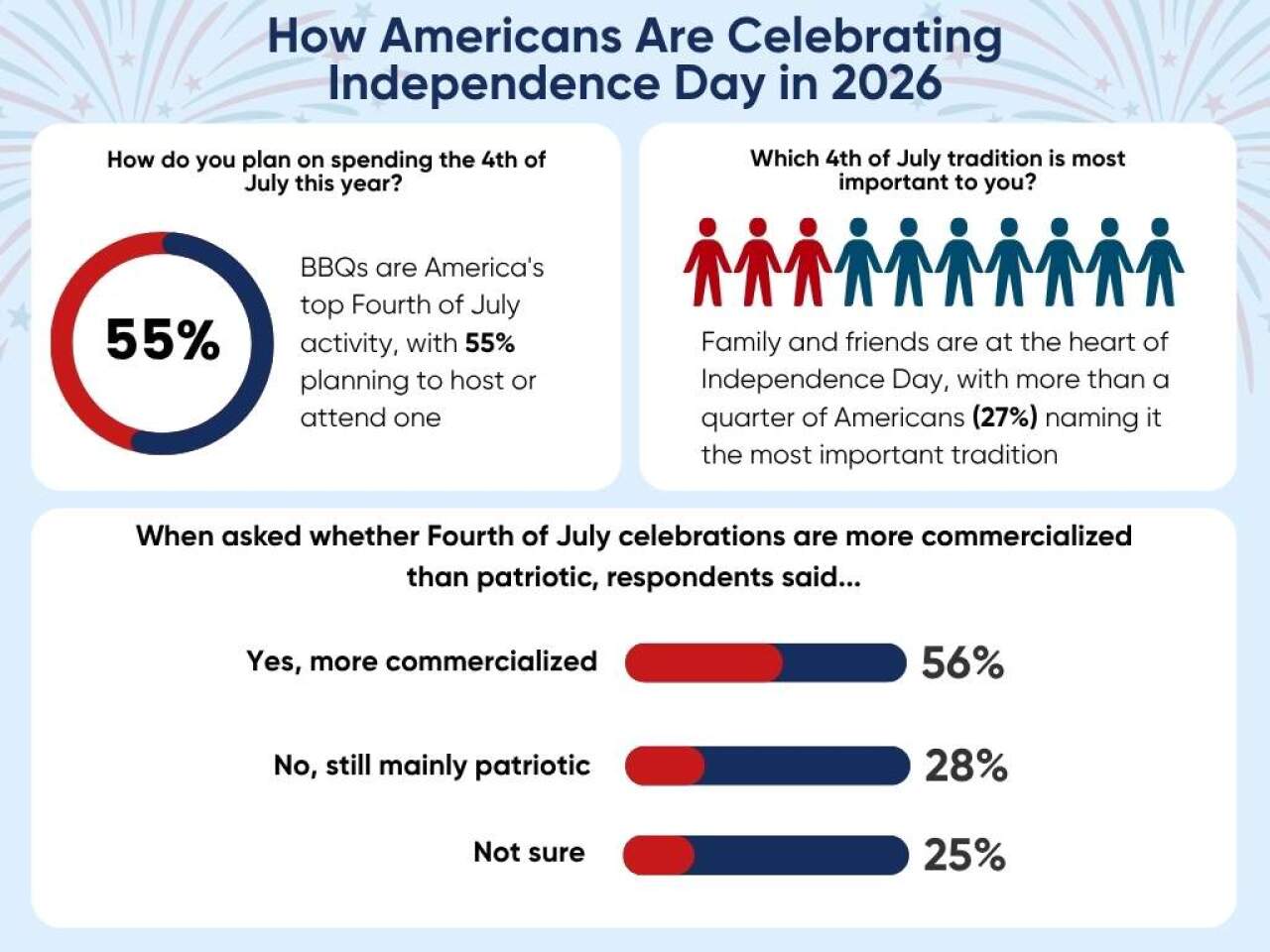
A data graphic revealing how Americans would be celebrating Independence Day in 2026.
Mecca Bingo


Cookouts and fireworks continue to define the fourth

When asked how they plan to celebrate Independence Day this year, Americans overwhelmingly pointed to two classic traditions.

More than half (55%) said they plan to host or attend a barbecue or cookout, making it the most popular Fourth of July activity in 2026. Fireworks remain nearly as popular, with 51% planning to attend a fireworks display.

Beyond those staples, celebrations become more varied. Nearly 1 in 5 Americans (18%) plan to attend a parade, while 16% expect to travel or take a vacation. Another 16% said they plan to spend time at a beach or lake, and 13% intend to attend a concert or festival.

At the same time, 17% reported that they don't typically celebrate the Fourth of July at all, highlighting that national holidays are becoming increasingly personal rather than universal.

Family comes before tradition

Although fireworks and cookouts dominate public celebrations, Americans say the people they're with matter more than the activities themselves.

When asked which Fourth of July tradition is most important to them, spending time with family and friends ranked first, selected by more than a quarter (27%) of respondents.

Fireworks followed at 24%, while barbecues and cookouts came in at 22%.

More traditional patriotic activities ranked significantly lower. Just 8% identified parades as the most important part of the holiday, while another 8% chose displaying the American flag. Patriotic concerts and music were selected by only 3% of respondents.

The results suggest that for many Americans, Independence Day has become less about formal patriotic observances and more about creating opportunities to gather with loved ones.

More Americans see commercialization than patriotism

While Americans continue to celebrate, many believe the holiday has changed over time.

A majority of respondents (57%) said Fourth of July celebrations today are more commercialized than patriotic. In contrast, under a third (29%) believe the holiday remains primarily patriotic, while 14% are unsure.

For many, the Fourth of July is less about symbolic displays and more about spending quality time with family, friends, and local communities.

Most Americans are staying close to home

Despite the holiday's reputation as a major travel weekend, most Americans aren't planning to go far this year.

Over half (54%) of Americans said they intend to stay local this Fourth of July. Under a third (29%) of Americans plan to travel somewhere within their state, whereas 17% expect to travel out of state, equating to roughly 44 million Americans.

Americans are celebrating with budgets in mind

Economic concerns are also influencing how people plan to celebrate this year.

Almost 1 in 4 (23%) expect to spend between $25 and $49 on their Fourth of July activities. Another 22% anticipate spending between $50 and $99, while 19% expect to spend less than $25.

One in 6 (15%) Americans plan to spend between $100 and $199, while only 6% expect to spend more than $200.

Notably, 15% said they don't plan to spend anything at all.

The numbers suggest that while Americans are still eager to celebrate, many are doing so with careful budgeting in mind.

Inflation is affecting holiday plans

For many households, rising costs are having a direct impact on how the holiday unfolds.

Two-thirds of Americans (66%) said higher prices have affected their Fourth of July plans in some way. More than a quarter (28%) reported being significantly affected, while 38% said rising costs had somewhat influenced their decisions.

Over a third (34%) said inflation had not impacted their plans.

Rather than canceling celebrations altogether, many Americans appear to be adapting by staying local, reducing spending, or focusing on lower-cost activities that still allow them to participate in the holiday.

A holiday that's evolving alongside America

The Fourth of July has changed dramatically over the decades. What began as a day centered on civic ceremonies and patriotic observances has expanded into a broader cultural event that includes travel, entertainment, food, and community gatherings.

The 2026 survey suggests Americans recognize those changes. Many believe the holiday has become increasingly commercialized, and rising costs are influencing how they celebrate.

Yet the core appeal of Independence Day remains remarkably consistent.

Whether they're gathering around a backyard grill, watching fireworks after sunset, or spending the day with family and friends, Americans continue to use the holiday as an opportunity to connect with the people around them.

In 2026, that sense of togetherness and family appears to be the tradition that matters most.

Methodology

To uncover the Fourth of July attitudes, Mecca Bingo conducted a nationwide survey of 2,000 U.S. respondents in June 2026. The survey is nationally representative of age (25+), gender and state.

This story was produced by Mecca Bingo and reviewed and distributed by Stacker.
 

Salem News Channel Today

Sponsored Links


September 26 - Phoenix, AZ
Scottsdale Center for the Performing Arts


November 2 - Detroit, MI
Zion Christian Church in Troy


October 6 - Los Angeles, CA
Pasadena Convention Center


November 5 - San Antonio, TX
Norris Centers – The Grand Red Oak Ballroom


October 8 - Sacramento, CA
William Jessup University


November 7 - Tampa, FL
The Palladium at St. Pete College


October 22 - Minneapolis, MN
Crowne Plaza AiRE


November 15 - San Francisco, CA
Fremont Marriott Silicon Valley


October 23 - Philadelphia, PA
Green Valley Country Club


November 16 - Denver, CO
CU South Denver - Formerly Wildlife Experience


November 2 - Chicago, IL
Chicago Westin Northwest in Itasca


November 21 - Cleveland, OH
Holiday Inn Rockside in Independence


Salem Radio Network Speakers

Larry Elder is an American lawyer, writer, and radio and television personality who calls himself the "Sage of South Central" a district of Los Angeles, Larry says his philosophy is to entertain, inform, provoke and to hopefully uplift. His calling card is "we have a country to save" and to him this means returning to the bedrock Constitutional principles of limited government and maximum personal responsibility. Elder's iconoclastic wit and intellectual agility makes him a particularly attractive voice in a nation that seems weary of traditional racial dialogue.” – Los Angeles Times.

Mike Gallagher Mike Gallagher began his broadcasting career in 1978 in Dayton, Ohio. Today, he is one of the most listened-to talk radio show hosts in America, recently having been ranked in the Talkers Magazine “Heavy Hundred” list – the 100 most important talk radio hosts in America. Prior to being launched into national syndication in 1998, Mike hosted the morning show on WABC-AM in New York City. Today, Talkers Magazine reports that his show is heard by over 3.75 million weekly listeners. Besides his radio work, Mike is seen on Fox News Channel as an on-air contributor, frequently appearing on the cable news giant.

Hugh Hewitt is one of the nation’s leading bloggers and a genuine media revolutionary. He brings that expertise, his wit and what The New Yorker magazine calls his “amiable but relentless manner” to his nationally syndicated show each day.

When Dr. Sebastian Gorka was growing up, he listened to talk radio under his pillow with a transistor radio, dreaming that one day he would be behind the microphone. Beginning New Year’s Day 2019, he got his wish. Gorka now hosts America First every weekday afternoon 3 to 6pm ET. Gorka’s unique story works well on the radio. He is national security analyst for the Fox News Channel and author of two books: "Why We Fight" and "Defeating Jihad." His latest book releasing this fall is “War For America’s Soul.” He is uniquely qualified to fight the culture war and stand up for what is great about America, his adopted home country.

Broadcasting from his home station of KRLA in Los Angeles, the Dennis Prager Show is heard across the country. Everything in life – from politics to religion to relationships – is grist for Dennis’ mill. If it’s interesting, if it affects your life, then Dennis will be talking about it – with passion, humor, insight and wisdom.

Sean Hannity is a conservative radio and television host, and one of the original primetime hosts on the Fox News Channel, where he has appeared since 1996. Sean Hannity began his radio career at a college station in California, before moving on to markets in the Southeast and New York. Today, he’s one of the most listened to on-air voices. Hannity’s radio program went into national syndication on September 10, 2001, and airs on more than 500 stations. Talkers Magazine estimates Hannity’s weekly radio audience at 13.5 million. In 1996 he was hired as one of the original hosts on Fox News Channel. As host of several popular Fox programs, Hannity has become the highest-paid news anchor on television.

Michelle Malkin is a mother, wife, blogger, conservative syndicated columnist, longtime cable TV news commentator, and best-selling author of six books. She started her newspaper journalism career at the Los Angeles Daily News in 1992, moved to the Seattle Times in 1995, and has been penning nationally syndicated newspaper columns for Creators Syndicate since 1999. She is founder of conservative Internet start-ups Hot Air and Twitchy.com. Malkin has received numerous awards for her investigative journalism, including the Council on Governmental Ethics Laws (COGEL) national award for outstanding service for the cause of governmental ethics and leadership (1998), the Reed Irvine Accuracy in Media Award for Investigative Journalism (2006), the Heritage Foundation and Franklin Center for Government & Public Integrity's Breitbart Award for Excellence in Journalism (2013), the Center for Immigration Studies' Eugene Katz Award for Excellence in the Coverage of Immigration Award (2016), and the Manhattan Film Festival's Film Heals Award (2018). Married for 26 years and the mother of two teenage children, she lives with her family in Colorado. Follow her at michellemalkin.com. (Photo reprinted with kind permission from Peter Duke Photography.)

Sponsored by:

The 4th of July is still about family, even as Americans feel the holiday is becoming more commercialized

Carbonatix Pre-Player Loader

Audio By Carbonatix

The 4th of July is still about family, even as Americans feel the holiday is becoming more commercialized

The Fourth of July has long been one of America's most recognizable traditions. From neighborhood cookouts and fireworks displays to road trips and community celebrations, Independence Day remains a summer staple for millions of Americans.

A recent survey of 2,000 U.S. respondents by Mecca Bingo suggests Americans are approaching the Fourth of July celebration a little differently in 2026. Rising prices, shifting priorities, and growing perceptions of commercialization are all influencing how people plan to spend the holiday weekend.

Even so, one thing remains unchanged: For most Americans, the Fourth of July is still fundamentally about spending time with family and friends.

A data graphic revealing how Americans would be celebrating Independence Day in 2026.
Mecca Bingo


Cookouts and fireworks continue to define the fourth

When asked how they plan to celebrate Independence Day this year, Americans overwhelmingly pointed to two classic traditions.

More than half (55%) said they plan to host or attend a barbecue or cookout, making it the most popular Fourth of July activity in 2026. Fireworks remain nearly as popular, with 51% planning to attend a fireworks display.

Beyond those staples, celebrations become more varied. Nearly 1 in 5 Americans (18%) plan to attend a parade, while 16% expect to travel or take a vacation. Another 16% said they plan to spend time at a beach or lake, and 13% intend to attend a concert or festival.

At the same time, 17% reported that they don't typically celebrate the Fourth of July at all, highlighting that national holidays are becoming increasingly personal rather than universal.

Family comes before tradition

Although fireworks and cookouts dominate public celebrations, Americans say the people they're with matter more than the activities themselves.

When asked which Fourth of July tradition is most important to them, spending time with family and friends ranked first, selected by more than a quarter (27%) of respondents.

Fireworks followed at 24%, while barbecues and cookouts came in at 22%.

More traditional patriotic activities ranked significantly lower. Just 8% identified parades as the most important part of the holiday, while another 8% chose displaying the American flag. Patriotic concerts and music were selected by only 3% of respondents.

The results suggest that for many Americans, Independence Day has become less about formal patriotic observances and more about creating opportunities to gather with loved ones.

More Americans see commercialization than patriotism

While Americans continue to celebrate, many believe the holiday has changed over time.

A majority of respondents (57%) said Fourth of July celebrations today are more commercialized than patriotic. In contrast, under a third (29%) believe the holiday remains primarily patriotic, while 14% are unsure.

For many, the Fourth of July is less about symbolic displays and more about spending quality time with family, friends, and local communities.

Most Americans are staying close to home

Despite the holiday's reputation as a major travel weekend, most Americans aren't planning to go far this year.

Over half (54%) of Americans said they intend to stay local this Fourth of July. Under a third (29%) of Americans plan to travel somewhere within their state, whereas 17% expect to travel out of state, equating to roughly 44 million Americans.

Americans are celebrating with budgets in mind

Economic concerns are also influencing how people plan to celebrate this year.

Almost 1 in 4 (23%) expect to spend between $25 and $49 on their Fourth of July activities. Another 22% anticipate spending between $50 and $99, while 19% expect to spend less than $25.

One in 6 (15%) Americans plan to spend between $100 and $199, while only 6% expect to spend more than $200.

Notably, 15% said they don't plan to spend anything at all.

The numbers suggest that while Americans are still eager to celebrate, many are doing so with careful budgeting in mind.

Inflation is affecting holiday plans

For many households, rising costs are having a direct impact on how the holiday unfolds.

Two-thirds of Americans (66%) said higher prices have affected their Fourth of July plans in some way. More than a quarter (28%) reported being significantly affected, while 38% said rising costs had somewhat influenced their decisions.

Over a third (34%) said inflation had not impacted their plans.

Rather than canceling celebrations altogether, many Americans appear to be adapting by staying local, reducing spending, or focusing on lower-cost activities that still allow them to participate in the holiday.

A holiday that's evolving alongside America

The Fourth of July has changed dramatically over the decades. What began as a day centered on civic ceremonies and patriotic observances has expanded into a broader cultural event that includes travel, entertainment, food, and community gatherings.

The 2026 survey suggests Americans recognize those changes. Many believe the holiday has become increasingly commercialized, and rising costs are influencing how they celebrate.

Yet the core appeal of Independence Day remains remarkably consistent.

Whether they're gathering around a backyard grill, watching fireworks after sunset, or spending the day with family and friends, Americans continue to use the holiday as an opportunity to connect with the people around them.

In 2026, that sense of togetherness and family appears to be the tradition that matters most.

Methodology

To uncover the Fourth of July attitudes, Mecca Bingo conducted a nationwide survey of 2,000 U.S. respondents in June 2026. The survey is nationally representative of age (25+), gender and state.

This story was produced by Mecca Bingo and reviewed and distributed by Stacker.

 

Salem News Channel Today

Sponsored Links

On Air & Up Next

See the Full Program Guide