The latest trends in commercial playground design

Carbonatix Pre-Player Loader

Audio By Carbonatix

The latest trends in commercial playground design

Modern playground design is about more than creating spaces for fun. Trends are moving away from traditional plastic slides and cookie-cutter monkey bars — today, playgrounds are built for holistic development and fostering connections between children, nature, and the world around them.

This guide from Playworld Preferred explores the nine latest trends in commercial playground design, so you can equip yourself with the tools you need to elevate playtime and nurture people’s experiences in the playground and beyond.

From making playgrounds more inclusive to embracing interactive technologies, discover how playground design is being reshaped in 2026.

Key Takeaways

  • Modern playground design emphasizes holistic development and fostering connections between children, nature, and their surroundings.
  • Inclusivity for all abilities and ages is a top priority in modern playground planning.
  • There’s a strong focus on integrating natural elements and sustainable practices into design.
  • Playgrounds are increasingly incorporating sensory features, fitness components, and interactive technologies to enhance engagement.
  • Designs are becoming more space-efficient and are catering to multigenerational use.

1. Prioritizing Inclusive Play

Fortunately, inclusive playgrounds are becoming more mainstream — inclusivity is a must-have feature for schools, parks, and public spaces alike.

Inclusive playground design is increasingly important for many reasons:

  • Fundamental right: Every child has a fundamental right to play, and your playground should encourage all children to enjoy their recreational breaks and outdoor activities.
  • Independence: Noninclusive playgrounds leave little room for independence for children who use mobility aids, wheelchairs, or alternative methods of communication. Inclusive playgrounds consider the needs of all children so that everyone can play safely and with confidence.
  • Mental health awareness: Today, there is increasing awareness and dialogue about mental health in our children and young adults. Creating inclusive play spaces can help reduce feelings of isolation, exclusion, and loneliness. Considering that, in a recent youth mental health study from The Child Mind Institute, 80% of both parents and young people reported loneliness and social isolation among their top three concerns, this benefit is more important than ever.
  • Holistic development for all: Enabling those with various abilities to participate in play does more than benefit their development. It also encourages neurotypical individuals to develop more empathy, patience, kindness, and other moral values. When all children are given the same play opportunities, they can all learn how to navigate their human differences and develop social skills in a safe environment.

Inclusive Playground Design Ideas
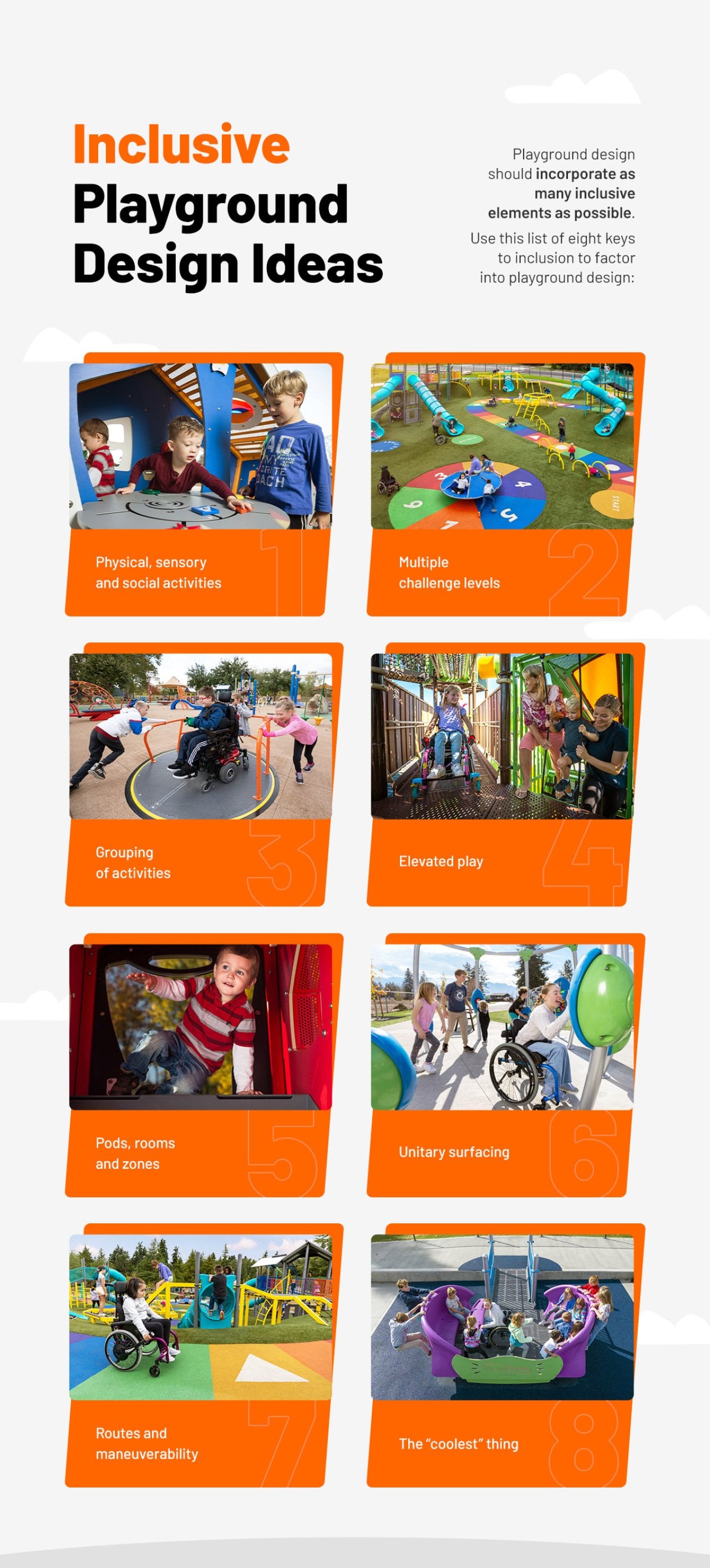
An infographic listing inclusive playground design ideas.
Playworld Preferred


Modern playgrounds offer many opportunities for improved inclusivity, ranging from minor alterations to a more intentional design process.

Playground design should incorporate as many inclusive elements as possible. Use this list of eight keys to inclusion to factor into playground design:

  1. Physical, sensory, and social activities: A mix of activities helps make the playground enjoyable for children of all abilities and needs.
  2. Multiple challenge levels: Choose play activities that provide graduated levels of challenge.
  3. Grouping of activities: Locate similar types of equipment in the same area to encourage play between children of diverse abilities.
  4. Elevated play: Ensure there are activities for all abilities at all elevations.
  5. Pods, rooms, and zones: Include specialized areas of play around either stimulating or calming activities.
  6. Unitary surfacing: Include a unitary, shock-absorbing surface that is wheelchair- and stroller-friendly.
  7. Routes and maneuverability: All routes through the playground and surrounding areas should be wide enough for people and wheelchairs to move with ease.
  8. The “coolest” thing: Every playground should feature an element that excites the children, and which can be accessible and usable for all.

Examples of inclusive playground design include:

  • Wheelchair-friendly surfacing: Accessibility starts from the ground up and begins with playground surfacing. Poured-in-place (PIP) rubber safety surfacing is considered one of the most accessible types, thanks to its unitary surface and high impact absorbance. Generally, loose-fill surfacing doesn’t cater to all children and should be avoided in accessible play areas.
  • Accessible entry and exit to play areas: To make sure everyone can enjoy accessible play areas and meet the requirements of the Americans with Disabilities Act, you must ensure safe and easy entrance and exit points. For example, you should add wheelchair ramps to meet raised surfaces.
  • Accessible tools: Playground designers are implementing a more diverse range of play equipment to cater to the diverse needs of all children. For example, many modern playgrounds have communication boards to encourage connection and facilitate play for those who use alternative communication methods.
  • Inclusive play equipment: You can find inclusive versions of typical play equipment to encourage use by everyone. For example, inclusive seesaws make it easy for wheelchair or mobility chair users to transfer themselves on and off the equipment with minimal assistance, depending on their unique needs.
  • Ground-level play components: A simple way to make playgrounds more inclusive is to make equipment physically more accessible by placing it at ground level. Examples of ground-level equipment include activity panels, tunnels, and puzzles.
  • Clear signage: For all playground rules and directions, your signs should accommodate a wide range of needs. For instance, they might include braille, audio buttons, bright contrasting colors, and clear universal symbols.

2. Incorporating Nature

Playgrounds are increasingly designed to mimic natural environments. This is achieved by incorporating natural playground materials, plants, and artificial play structures based on natural elements.

The benefits of nature-themed playgrounds include:

  • Enhanced connection with nature: Children who play in natural environments have the opportunity to connect with the world around them. They can find fun in more traditional ways, which can be invaluable in our technology-driven society.
  • Increased environmental awareness: Nature-inspired playgrounds offer parents and teachers the opportunity to spread practical awareness about sustainability, conservation, and natural life beyond traditional teaching methods in the classroom.
  • Encouraged biodiversity: Using natural materials like logs, trees, and plants can create habitable environments for flora and fauna, and can further children’s appreciation for Mother Nature.
  • Improved mental health: Nature-based experiences are proven to support cognitive and emotional development, and can reduce anxiety and irritability.
  • Improved air quality: Incorporating plants and trees into playground design can decrease airborne pollutants and increase oxygen levels, which can improve air quality for our children.
  • Aesthetic appeal: Natural materials can give playgrounds a timeless appeal and help them blend into their surroundings.

3. Sustainability

Sustainability is a nonnegotiable consideration for playground design in 2026. Sustainable building practices are not only expected in our current climate, but sustainable school architecture is more necessary than ever.

Sustainable playground design practices include:

  • Using eco-friendly materials: Many playground designers are using recycled, renewable, and natural materials to create play apparatus and equipment. For example, many PIP safety surfacing materials are made from recycled rubber, and plenty of playground equipment can be made from recycled plastic.
  • Choosing drought-friendly plants: To reduce water consumption, you can choose low-maintenance, drought-friendly plants and shrubs for your commercial playgrounds.
  • Investing in high-quality suppliers: Investing in companies that provide long-lasting, high-quality playground components is a great way to minimize your environmental impact by making your products go further. For example, you can opt for surfacing with UV resistance, equipment with high corrosion and abrasion resistance, and products that have undergone impact testing.

Incorporating sustainability into your playground is not just about doing what’s best for the planet — it’s also about doing what’s best for your budget and resources.

Often, the most sustainable and high-quality playground components are also the ones that require less long-term investment and upkeep. By investing in materials with fewer needs and longer lifespans, you can make your resources go further.

4. Themes

Choosing a theme for your playground is a great way to encourage children’s imaginations and sense of adventure. Themed playgrounds are stimulating for children across a wide range of age groups, enabling them to enjoy physical activity while developing cognitively through thematic cues.

Popular playground themes include:

  • Farmyard
  • Intergalactic/space
  • Nautical
  • Community identity
  • Prehistoric

Often, school playground themes can reinforce curricular subjects to enhance learning beyond the classroom.

5. Sensory Elements

Playgrounds are ideal environments for incorporating sensory elements for holistic development. Studies have shown that sensory play experiences can positively impact children’s cognitive development, and that tactile interactions with different textures can encourage social and emotional growth.
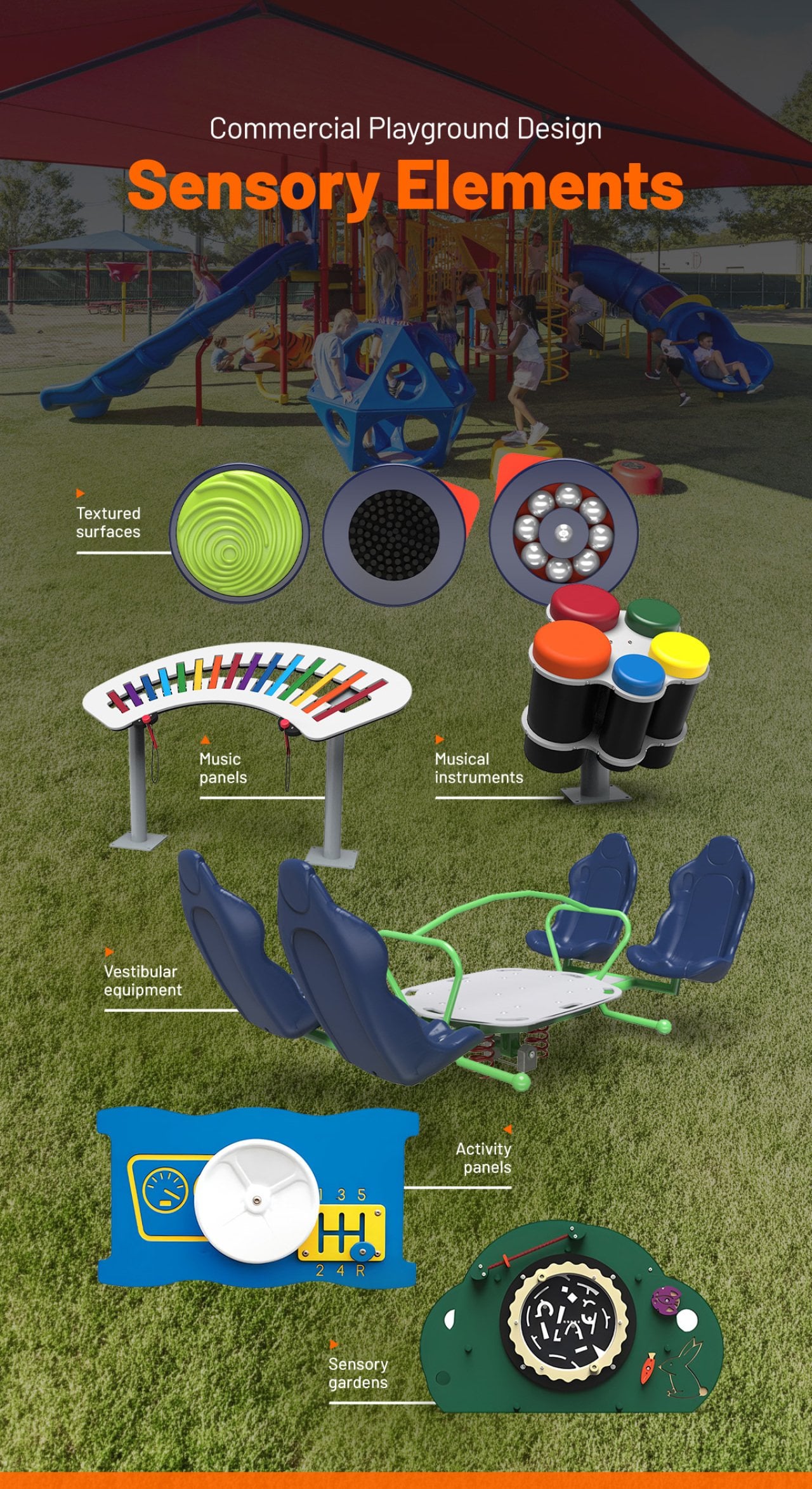
An infographic showing the sensory elements in a commercial playground design.
Playworld Preferred


Examples of sensory elements in playgrounds include:

  • Textured surfaces: From sensory panels to climbing walls, different textures can encourage tactile stimulation and help support motor skill development.
  • Music panels: Auditory stimulation can enhance language acquisition, reading, and writing skills in children. You can add music and sound panels to playground walls and equipment to encourage interactive play.
  • Musical instruments: Weather-resistant musical instruments can foster creativity and provide unique play experiences.
  • Activity panels: Panels featuring wheels, dials, gears, and other tactile activities promote imaginative play.
  • Sensory gardens: Gardens dedicated to growing colorful plants and scented flowers can stimulate multiple senses at the same time, while also encouraging an interest in the natural world.
  • Vestibular equipment: Vestibular devices and equipment help children develop their balance, coordination, and reflexes. Playground examples include balance beams, wobbly bridges, and swings.

6. Fitness Integration

One rising trend in playground design is the integration of fitness activities and elements that encourage physical activity. The benefits of integrating fitness into playgrounds include:

  • Fosters social integration: With the continual increase in screen-based activities, physical fitness offers a much-needed opportunity for our children and community members to connect with one another in the real world.
  • Encourages outdoor time: Having specific activities to focus on in the playground helps make outdoor time more appealing, incentivizing, and enjoyable.
  • Promotes physical health: By disguising fitness as fun, you can more easily encourage people to take part in activities that are good for their mind and body.

Examples of fitness features in playgrounds include:

  • Obstacle courses.
  • Outdoor gym equipment.
  • Calisthenics apparatus.
  • Body weight training stations.
  • Motion sensors and activity tracking devices.
  • Sports equipment and courts.

7. Interactive Technology

Although playgrounds are ideal for encouraging time away from some types of technology, you can also integrate interactive technology that aids development and activity.

Using interactive technology in playgrounds is a great way to encourage learning through play. By using motion-activated, sound-producing, and light-up features, you can create unique interactive experiences that ignite children’s imaginations and increase their engagement during playtime.

Examples of interactive technology for playgrounds include electronic play devices, such as hand-powered audio walls.

8. Multigenerational Focus

Playgrounds are not solely for young children, and teens and adults are often unconsidered when it comes to commercial playground design.

When you maintain a multigenerational focus, you can create spaces that encourage participation and activity among all community members. Multigenerational design is particularly beneficial in commercial playgrounds outside of educational settings, where a wider range of individuals can enjoy the space, such as in parks and community centers.

Cross-generational spaces can have lasting positive impacts on adults and children alike, creating a sense of community and potentially improving people’s quality of life. You can enhance cross-generational participation by:

  • Designing for all ages: Provide developmentally appropriate play opportunities for infants and toddlers (12-24 months), early childhood (2-5 years), school-age children (5-12 years), teens and adults (13+).
  • Integrating movement beyond the playground: Surround the play area with walking paths, loop trails, and adjacent play fields to encourage continuous, multigenerational physical activity.
  • Accommodating diverse body types: Select equipment that comfortably supports a wide range of sizes, strengths, and mobility levels, enabling meaningful participation for everyone.
  • Including large, open-ended structures: Incorporate flexible play elements that invite imagination and collaboration, and encourage parents to play alongside their children.
  • Creating social gathering spaces: Design intentional places to rest, connect, and hang out, supporting peer interaction, family engagement, and community building.
  • Being deliberate with site amenities: Provide comfortable seating, tables, shade, accessible restrooms, and thoughtful lighting to extend length of stay and enhance comfort, safety, and usability.
  • Incorporating fitness and exercise opportunities: Include inclusive fitness equipment that encourages strength, balance, cardiovascular activity, and active aging.
  • Embedding games and playful challenges: Integrate interactive games and playful elements throughout the site to promote engagement, social play, and lifelong participation.

9. Space-Efficient Designs

Space-efficient playground design maximizes your ability to create impactful play opportunities in limited environments, benefiting both the users of the playground and your build budget.

Examples of space-efficient playground elements include:

  • Multilevel structures: Multilevel structures maximize your available space by featuring different activities on each level. For example, a three-tier play structure could combine a high tower play space with a slide and a ground-level puzzle area.
  • Vertical play equipment: Features like play hills and climbing walls require very little ground space yet deliver high-quality experiences.
  • Compact apparatus: You can choose compact versions of traditional playground equipment to maximize your space’s versatility, such as single swings and spiral slides.
  • Overhead equipment: You can install overhead features that require minimal floor space, such as bridges and skywalks.

Incorporate These 2026 Trends Into Your Playground Design

Playground design is shifting away from simplicity. Today’s approach to commercial playground design blends creativity, purpose, and community impact to transform the world of play.

While sensory elements, interactive technology features, and inclusive designs support holistic development, the focus on sustainability and space efficiency aims to see your creations go further.

Together, the latest trends in commercial, cross-generational playground design reflect a transition toward more intentional spaces. These play environments foster emotional, social, and cognitive development while also meeting the varying practical needs of our communities.

This story was produced by Playworld Preferred and reviewed and distributed by Stacker.

 

Salem News Channel Today

Sponsored Links


September 26 - Phoenix, AZ
Scottsdale Center for the Performing Arts


November 2 - Detroit, MI
Zion Christian Church in Troy


October 6 - Los Angeles, CA
Pasadena Convention Center


November 5 - San Antonio, TX
Norris Centers – The Grand Red Oak Ballroom


October 8 - Sacramento, CA
William Jessup University


November 7 - Tampa, FL
The Palladium at St. Pete College


October 22 - Minneapolis, MN
Crowne Plaza AiRE


November 15 - San Francisco, CA
Fremont Marriott Silicon Valley


October 23 - Philadelphia, PA
Green Valley Country Club


November 16 - Denver, CO
CU South Denver - Formerly Wildlife Experience


November 2 - Chicago, IL
Chicago Westin Northwest in Itasca


November 21 - Cleveland, OH
Holiday Inn Rockside in Independence


Salem Radio Network Speakers

Larry Elder is an American lawyer, writer, and radio and television personality who calls himself the "Sage of South Central" a district of Los Angeles, Larry says his philosophy is to entertain, inform, provoke and to hopefully uplift. His calling card is "we have a country to save" and to him this means returning to the bedrock Constitutional principles of limited government and maximum personal responsibility. Elder's iconoclastic wit and intellectual agility makes him a particularly attractive voice in a nation that seems weary of traditional racial dialogue.” – Los Angeles Times.

Mike Gallagher Mike Gallagher began his broadcasting career in 1978 in Dayton, Ohio. Today, he is one of the most listened-to talk radio show hosts in America, recently having been ranked in the Talkers Magazine “Heavy Hundred” list – the 100 most important talk radio hosts in America. Prior to being launched into national syndication in 1998, Mike hosted the morning show on WABC-AM in New York City. Today, Talkers Magazine reports that his show is heard by over 3.75 million weekly listeners. Besides his radio work, Mike is seen on Fox News Channel as an on-air contributor, frequently appearing on the cable news giant.

Hugh Hewitt is one of the nation’s leading bloggers and a genuine media revolutionary. He brings that expertise, his wit and what The New Yorker magazine calls his “amiable but relentless manner” to his nationally syndicated show each day.

When Dr. Sebastian Gorka was growing up, he listened to talk radio under his pillow with a transistor radio, dreaming that one day he would be behind the microphone. Beginning New Year’s Day 2019, he got his wish. Gorka now hosts America First every weekday afternoon 3 to 6pm ET. Gorka’s unique story works well on the radio. He is national security analyst for the Fox News Channel and author of two books: "Why We Fight" and "Defeating Jihad." His latest book releasing this fall is “War For America’s Soul.” He is uniquely qualified to fight the culture war and stand up for what is great about America, his adopted home country.

Broadcasting from his home station of KRLA in Los Angeles, the Dennis Prager Show is heard across the country. Everything in life – from politics to religion to relationships – is grist for Dennis’ mill. If it’s interesting, if it affects your life, then Dennis will be talking about it – with passion, humor, insight and wisdom.

Sean Hannity is a conservative radio and television host, and one of the original primetime hosts on the Fox News Channel, where he has appeared since 1996. Sean Hannity began his radio career at a college station in California, before moving on to markets in the Southeast and New York. Today, he’s one of the most listened to on-air voices. Hannity’s radio program went into national syndication on September 10, 2001, and airs on more than 500 stations. Talkers Magazine estimates Hannity’s weekly radio audience at 13.5 million. In 1996 he was hired as one of the original hosts on Fox News Channel. As host of several popular Fox programs, Hannity has become the highest-paid news anchor on television.

Michelle Malkin is a mother, wife, blogger, conservative syndicated columnist, longtime cable TV news commentator, and best-selling author of six books. She started her newspaper journalism career at the Los Angeles Daily News in 1992, moved to the Seattle Times in 1995, and has been penning nationally syndicated newspaper columns for Creators Syndicate since 1999. She is founder of conservative Internet start-ups Hot Air and Twitchy.com. Malkin has received numerous awards for her investigative journalism, including the Council on Governmental Ethics Laws (COGEL) national award for outstanding service for the cause of governmental ethics and leadership (1998), the Reed Irvine Accuracy in Media Award for Investigative Journalism (2006), the Heritage Foundation and Franklin Center for Government & Public Integrity's Breitbart Award for Excellence in Journalism (2013), the Center for Immigration Studies' Eugene Katz Award for Excellence in the Coverage of Immigration Award (2016), and the Manhattan Film Festival's Film Heals Award (2018). Married for 26 years and the mother of two teenage children, she lives with her family in Colorado. Follow her at michellemalkin.com. (Photo reprinted with kind permission from Peter Duke Photography.)

Sponsored by:

The latest trends in commercial playground design

Carbonatix Pre-Player Loader

Audio By Carbonatix

The latest trends in commercial playground design

Modern playground design is about more than creating spaces for fun. Trends are moving away from traditional plastic slides and cookie-cutter monkey bars — today, playgrounds are built for holistic development and fostering connections between children, nature, and the world around them.

This guide from Playworld Preferred explores the nine latest trends in commercial playground design, so you can equip yourself with the tools you need to elevate playtime and nurture people’s experiences in the playground and beyond.

From making playgrounds more inclusive to embracing interactive technologies, discover how playground design is being reshaped in 2026.

Key Takeaways

  • Modern playground design emphasizes holistic development and fostering connections between children, nature, and their surroundings.
  • Inclusivity for all abilities and ages is a top priority in modern playground planning.
  • There’s a strong focus on integrating natural elements and sustainable practices into design.
  • Playgrounds are increasingly incorporating sensory features, fitness components, and interactive technologies to enhance engagement.
  • Designs are becoming more space-efficient and are catering to multigenerational use.

1. Prioritizing Inclusive Play

Fortunately, inclusive playgrounds are becoming more mainstream — inclusivity is a must-have feature for schools, parks, and public spaces alike.

Inclusive playground design is increasingly important for many reasons:

  • Fundamental right: Every child has a fundamental right to play, and your playground should encourage all children to enjoy their recreational breaks and outdoor activities.
  • Independence: Noninclusive playgrounds leave little room for independence for children who use mobility aids, wheelchairs, or alternative methods of communication. Inclusive playgrounds consider the needs of all children so that everyone can play safely and with confidence.
  • Mental health awareness: Today, there is increasing awareness and dialogue about mental health in our children and young adults. Creating inclusive play spaces can help reduce feelings of isolation, exclusion, and loneliness. Considering that, in a recent youth mental health study from The Child Mind Institute, 80% of both parents and young people reported loneliness and social isolation among their top three concerns, this benefit is more important than ever.
  • Holistic development for all: Enabling those with various abilities to participate in play does more than benefit their development. It also encourages neurotypical individuals to develop more empathy, patience, kindness, and other moral values. When all children are given the same play opportunities, they can all learn how to navigate their human differences and develop social skills in a safe environment.

Inclusive Playground Design Ideas

An infographic listing inclusive playground design ideas.
Playworld Preferred


Modern playgrounds offer many opportunities for improved inclusivity, ranging from minor alterations to a more intentional design process.

Playground design should incorporate as many inclusive elements as possible. Use this list of eight keys to inclusion to factor into playground design:

  1. Physical, sensory, and social activities: A mix of activities helps make the playground enjoyable for children of all abilities and needs.
  2. Multiple challenge levels: Choose play activities that provide graduated levels of challenge.
  3. Grouping of activities: Locate similar types of equipment in the same area to encourage play between children of diverse abilities.
  4. Elevated play: Ensure there are activities for all abilities at all elevations.
  5. Pods, rooms, and zones: Include specialized areas of play around either stimulating or calming activities.
  6. Unitary surfacing: Include a unitary, shock-absorbing surface that is wheelchair- and stroller-friendly.
  7. Routes and maneuverability: All routes through the playground and surrounding areas should be wide enough for people and wheelchairs to move with ease.
  8. The “coolest” thing: Every playground should feature an element that excites the children, and which can be accessible and usable for all.

Examples of inclusive playground design include:

  • Wheelchair-friendly surfacing: Accessibility starts from the ground up and begins with playground surfacing. Poured-in-place (PIP) rubber safety surfacing is considered one of the most accessible types, thanks to its unitary surface and high impact absorbance. Generally, loose-fill surfacing doesn’t cater to all children and should be avoided in accessible play areas.
  • Accessible entry and exit to play areas: To make sure everyone can enjoy accessible play areas and meet the requirements of the Americans with Disabilities Act, you must ensure safe and easy entrance and exit points. For example, you should add wheelchair ramps to meet raised surfaces.
  • Accessible tools: Playground designers are implementing a more diverse range of play equipment to cater to the diverse needs of all children. For example, many modern playgrounds have communication boards to encourage connection and facilitate play for those who use alternative communication methods.
  • Inclusive play equipment: You can find inclusive versions of typical play equipment to encourage use by everyone. For example, inclusive seesaws make it easy for wheelchair or mobility chair users to transfer themselves on and off the equipment with minimal assistance, depending on their unique needs.
  • Ground-level play components: A simple way to make playgrounds more inclusive is to make equipment physically more accessible by placing it at ground level. Examples of ground-level equipment include activity panels, tunnels, and puzzles.
  • Clear signage: For all playground rules and directions, your signs should accommodate a wide range of needs. For instance, they might include braille, audio buttons, bright contrasting colors, and clear universal symbols.

2. Incorporating Nature

Playgrounds are increasingly designed to mimic natural environments. This is achieved by incorporating natural playground materials, plants, and artificial play structures based on natural elements.

The benefits of nature-themed playgrounds include:

  • Enhanced connection with nature: Children who play in natural environments have the opportunity to connect with the world around them. They can find fun in more traditional ways, which can be invaluable in our technology-driven society.
  • Increased environmental awareness: Nature-inspired playgrounds offer parents and teachers the opportunity to spread practical awareness about sustainability, conservation, and natural life beyond traditional teaching methods in the classroom.
  • Encouraged biodiversity: Using natural materials like logs, trees, and plants can create habitable environments for flora and fauna, and can further children’s appreciation for Mother Nature.
  • Improved mental health: Nature-based experiences are proven to support cognitive and emotional development, and can reduce anxiety and irritability.
  • Improved air quality: Incorporating plants and trees into playground design can decrease airborne pollutants and increase oxygen levels, which can improve air quality for our children.
  • Aesthetic appeal: Natural materials can give playgrounds a timeless appeal and help them blend into their surroundings.

3. Sustainability

Sustainability is a nonnegotiable consideration for playground design in 2026. Sustainable building practices are not only expected in our current climate, but sustainable school architecture is more necessary than ever.

Sustainable playground design practices include:

  • Using eco-friendly materials: Many playground designers are using recycled, renewable, and natural materials to create play apparatus and equipment. For example, many PIP safety surfacing materials are made from recycled rubber, and plenty of playground equipment can be made from recycled plastic.
  • Choosing drought-friendly plants: To reduce water consumption, you can choose low-maintenance, drought-friendly plants and shrubs for your commercial playgrounds.
  • Investing in high-quality suppliers: Investing in companies that provide long-lasting, high-quality playground components is a great way to minimize your environmental impact by making your products go further. For example, you can opt for surfacing with UV resistance, equipment with high corrosion and abrasion resistance, and products that have undergone impact testing.

Incorporating sustainability into your playground is not just about doing what’s best for the planet — it’s also about doing what’s best for your budget and resources.

Often, the most sustainable and high-quality playground components are also the ones that require less long-term investment and upkeep. By investing in materials with fewer needs and longer lifespans, you can make your resources go further.

4. Themes

Choosing a theme for your playground is a great way to encourage children’s imaginations and sense of adventure. Themed playgrounds are stimulating for children across a wide range of age groups, enabling them to enjoy physical activity while developing cognitively through thematic cues.

Popular playground themes include:

  • Farmyard
  • Intergalactic/space
  • Nautical
  • Community identity
  • Prehistoric

Often, school playground themes can reinforce curricular subjects to enhance learning beyond the classroom.

5. Sensory Elements

Playgrounds are ideal environments for incorporating sensory elements for holistic development. Studies have shown that sensory play experiences can positively impact children’s cognitive development, and that tactile interactions with different textures can encourage social and emotional growth.

An infographic showing the sensory elements in a commercial playground design.
Playworld Preferred


Examples of sensory elements in playgrounds include:

  • Textured surfaces: From sensory panels to climbing walls, different textures can encourage tactile stimulation and help support motor skill development.
  • Music panels: Auditory stimulation can enhance language acquisition, reading, and writing skills in children. You can add music and sound panels to playground walls and equipment to encourage interactive play.
  • Musical instruments: Weather-resistant musical instruments can foster creativity and provide unique play experiences.
  • Activity panels: Panels featuring wheels, dials, gears, and other tactile activities promote imaginative play.
  • Sensory gardens: Gardens dedicated to growing colorful plants and scented flowers can stimulate multiple senses at the same time, while also encouraging an interest in the natural world.
  • Vestibular equipment: Vestibular devices and equipment help children develop their balance, coordination, and reflexes. Playground examples include balance beams, wobbly bridges, and swings.

6. Fitness Integration

One rising trend in playground design is the integration of fitness activities and elements that encourage physical activity. The benefits of integrating fitness into playgrounds include:

  • Fosters social integration: With the continual increase in screen-based activities, physical fitness offers a much-needed opportunity for our children and community members to connect with one another in the real world.
  • Encourages outdoor time: Having specific activities to focus on in the playground helps make outdoor time more appealing, incentivizing, and enjoyable.
  • Promotes physical health: By disguising fitness as fun, you can more easily encourage people to take part in activities that are good for their mind and body.

Examples of fitness features in playgrounds include:

  • Obstacle courses.
  • Outdoor gym equipment.
  • Calisthenics apparatus.
  • Body weight training stations.
  • Motion sensors and activity tracking devices.
  • Sports equipment and courts.

7. Interactive Technology

Although playgrounds are ideal for encouraging time away from some types of technology, you can also integrate interactive technology that aids development and activity.

Using interactive technology in playgrounds is a great way to encourage learning through play. By using motion-activated, sound-producing, and light-up features, you can create unique interactive experiences that ignite children’s imaginations and increase their engagement during playtime.

Examples of interactive technology for playgrounds include electronic play devices, such as hand-powered audio walls.

8. Multigenerational Focus

Playgrounds are not solely for young children, and teens and adults are often unconsidered when it comes to commercial playground design.

When you maintain a multigenerational focus, you can create spaces that encourage participation and activity among all community members. Multigenerational design is particularly beneficial in commercial playgrounds outside of educational settings, where a wider range of individuals can enjoy the space, such as in parks and community centers.

Cross-generational spaces can have lasting positive impacts on adults and children alike, creating a sense of community and potentially improving people’s quality of life. You can enhance cross-generational participation by:

  • Designing for all ages: Provide developmentally appropriate play opportunities for infants and toddlers (12-24 months), early childhood (2-5 years), school-age children (5-12 years), teens and adults (13+).
  • Integrating movement beyond the playground: Surround the play area with walking paths, loop trails, and adjacent play fields to encourage continuous, multigenerational physical activity.
  • Accommodating diverse body types: Select equipment that comfortably supports a wide range of sizes, strengths, and mobility levels, enabling meaningful participation for everyone.
  • Including large, open-ended structures: Incorporate flexible play elements that invite imagination and collaboration, and encourage parents to play alongside their children.
  • Creating social gathering spaces: Design intentional places to rest, connect, and hang out, supporting peer interaction, family engagement, and community building.
  • Being deliberate with site amenities: Provide comfortable seating, tables, shade, accessible restrooms, and thoughtful lighting to extend length of stay and enhance comfort, safety, and usability.
  • Incorporating fitness and exercise opportunities: Include inclusive fitness equipment that encourages strength, balance, cardiovascular activity, and active aging.
  • Embedding games and playful challenges: Integrate interactive games and playful elements throughout the site to promote engagement, social play, and lifelong participation.

9. Space-Efficient Designs

Space-efficient playground design maximizes your ability to create impactful play opportunities in limited environments, benefiting both the users of the playground and your build budget.

Examples of space-efficient playground elements include:

  • Multilevel structures: Multilevel structures maximize your available space by featuring different activities on each level. For example, a three-tier play structure could combine a high tower play space with a slide and a ground-level puzzle area.
  • Vertical play equipment: Features like play hills and climbing walls require very little ground space yet deliver high-quality experiences.
  • Compact apparatus: You can choose compact versions of traditional playground equipment to maximize your space’s versatility, such as single swings and spiral slides.
  • Overhead equipment: You can install overhead features that require minimal floor space, such as bridges and skywalks.

Incorporate These 2026 Trends Into Your Playground Design

Playground design is shifting away from simplicity. Today’s approach to commercial playground design blends creativity, purpose, and community impact to transform the world of play.

While sensory elements, interactive technology features, and inclusive designs support holistic development, the focus on sustainability and space efficiency aims to see your creations go further.

Together, the latest trends in commercial, cross-generational playground design reflect a transition toward more intentional spaces. These play environments foster emotional, social, and cognitive development while also meeting the varying practical needs of our communities.

This story was produced by Playworld Preferred and reviewed and distributed by Stacker.

 

Salem News Channel Today

Sponsored Links

On Air & Up Next

See the Full Program Guide