Why have student test scores been declining for a decade in America?

Carbonatix Pre-Player Loader

Audio By Carbonatix

Why have student test scores been declining for a decade in America?

It’s hardly breaking news that American students are behind academically from where they used to be.

But the specifics can get lost in a haze of headlines and data points. Chalkbeat reviewed multiple pieces of testing data to find out where U.S. students stand on learning loss and recovery.

In sum: Test scores have been trending down for over a decade. There are some signs of recovery in math, but not many in reading. Learning declines are not a distinctly U.S. phenomenon and are not even limited to schoolchildren. Researchers are only just beginning to wrap their heads around the causes of this.

Confident claims about what’s going on here are unwarranted, though policymakers can’t wait for perfect evidence to act.

“We should resist the notion of trying to put our finger on the one thing we can change that will solve this problem,” says University of Virginia researcher James Wyckoff, who recently released a paper on declining achievement. “I think it really results from many things in and out of school.”

Here are some key takeaways from the review of the data.

Learning declines have been substantial and pervasive.
Consider one example from the National Assessment of Educational Progress, or NAEP: In 2013, 74% of American eighth graders scored at the basic or above level in math, the highest figure since the test started in 1990. In the most recent round that number fell to 61%, hitting levels last seen in 1996. Scores have fallen in other grades and subjects, too.

Despite a small handful of relative bright spots, these declines have been remarkably widespread. Eighth grade math scores fell in almost every single state during this period; no states saw increases. Although schools that were closed longer during the pandemic tended to experience bigger declines, even those that quickly reopened have been hit hard by learning loss.
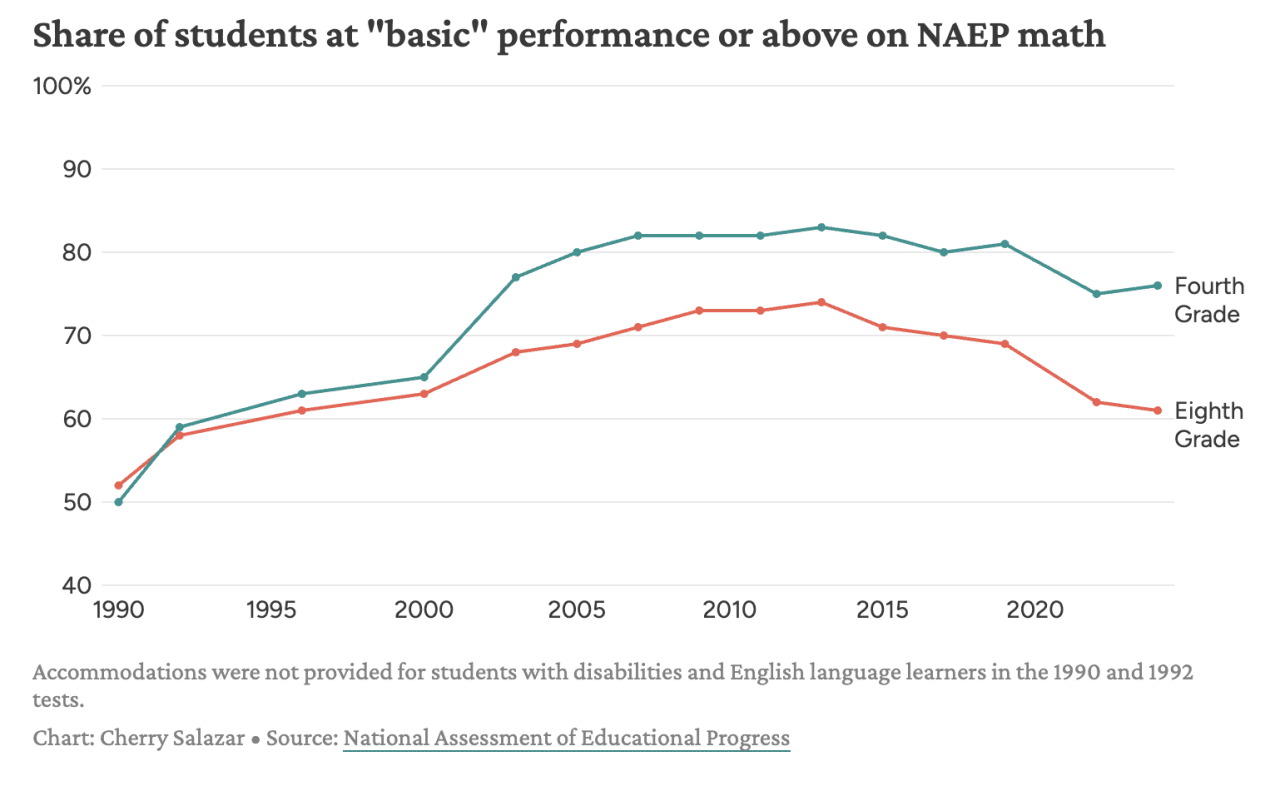
A line graph showing the share of students in fourth grade and eighth grade from 1990 to 2020 at basic performance or above on the National Assessment of Educational Progress.
Cherry Salazar // Chalkbeat


This trend started before the pandemic.
Test scores, particularly in math, had generally been marching upwards for a few decades until about 2013. Then a period of stagnation and decline hit. The aftershocks of the Great Recession on families and school budgets may have been an initial cause. Yet even by 2019 there was still no sign of recovery. Then the bottom fell out further after the pandemic.

Two groups have been hit hardest: low performers and girls.
On a wide variety of tests, starting before the pandemic, the gap between the lowest- and highest-performing students has grown. That’s not because high performers have surged ahead but because low performers have fallen further behind.

More recently, since the pandemic, girls’ scores have tended to fall more sharply than boys’.

Some good news: Math scores are starting to trend up again.
Every state with consistent testing data shows that more students are reaching proficiency in math now compared to 2021. Math results have also ticked up on the NWEA exam and on the fourth grade (but not eighth grade) NAEP. Still, most data indicates that these scores have not bounced back to pre-pandemic levels.

There’s been inconsistent recovery at best in reading.
Reading and math results have followed curiously different trajectories. On the most recent NAEP, reading scores actually fell even further. On state exams, reading achievement has been all over the map. Pennsylvania, for instance, has had solid recovery in math, but reading scores have kept sliding downward.
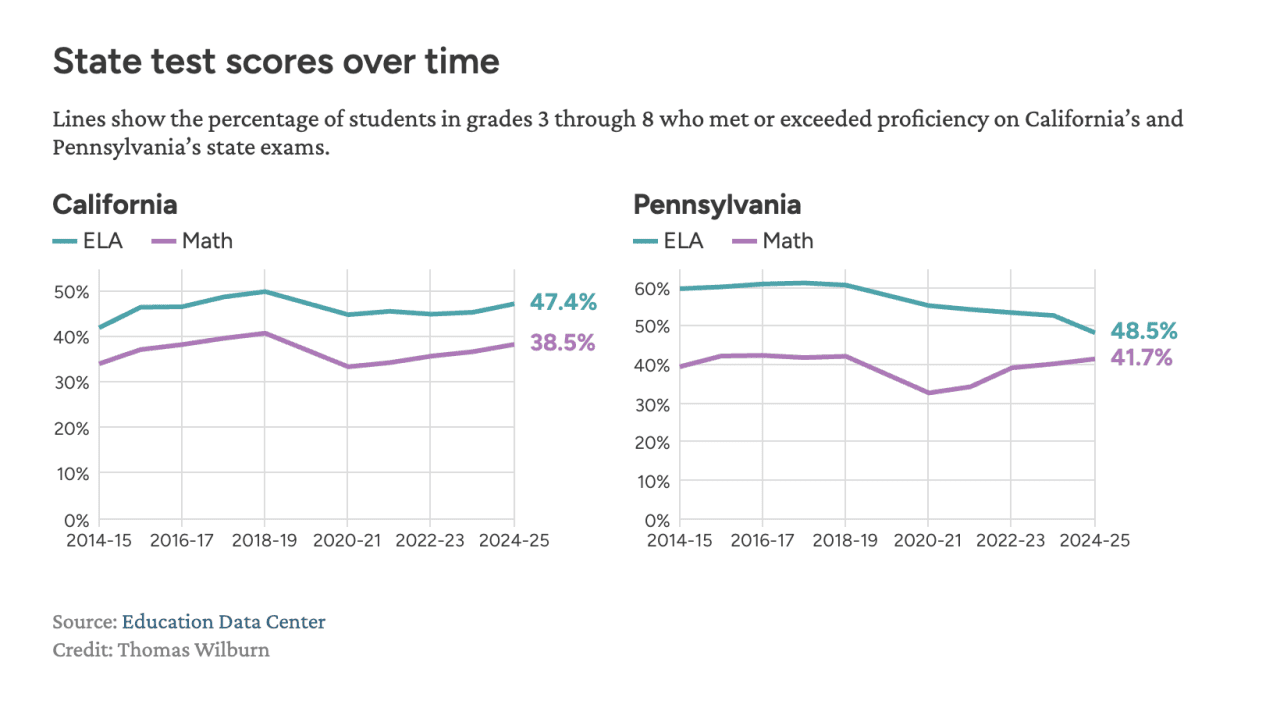
Two line graphs showing the percentage of students in grades 3 through 8 who met or exceeded proficiency on California and Pennsylvania's state exams.
Thomas Wilburn // Chalkbeat


The U.S. is hardly alone in its achievement woes.
Many other countries are grappling with falling test scores, too. This has shown up on an exam of 15-year-olds known as the PISA, as well as on the TIMSS, a math and science test of fourth and eighth graders. Relative to the rest of the world, the U.S. trends look a bit worse on TIMSS, but a bit better on PISA.

The U.S. is unusual in its sharply growing gap between the highest- and lowest-performing students.

Also, test scores may be lower among adults and very young children.
Some data indicates that children who are just entering school are doing so with lower levels of readiness in reading and math. Another study of adult skills showed drops across the age distribution between 2017 and 2023 in literacy and numeracy.

This adds a new wrinkle. “Factors outside of school might play a considerable role” in learning declines, writes Nat Malkus of the American Enterprise Institute in a report from last year.

How concerned should we be? Pretty concerned!
When children know more, as measured on tests, they tend to lead more productive lives. Countries with higher test scores tend to see stronger economic growth. These scores are incomplete measures of students’ skills, but they do matter.

Test scores are not in entirely uncharted territory, though. A long-running test of 13-year-olds shows that math scores in 2023 were at the lowest point in recent decades but remain comparable to scores from the ‘80s and early ‘90s and higher than those in the ‘70s. Reading scores have dipped to levels last seen in the early 2000s.

So what explains all this? Researchers aren’t quite sure.
Two detailed analyses, by Wyckoff and Malkus, have tried to parse what is driving these trends. Neither concluded with definitive answers. “There is remarkably little understanding of the nature of either the sustained achievement gains prior to 2013 or the subsequent losses thereafter,” writes Wyckoff in his paper, titled “Puzzling Over Declining Academic Achievement.”

That said, it’s very likely that the pandemic and its associated disruptions to life in and out of school played a significant role. Another theory is that easing off school accountability pressure — which research found drove learning gains in the early 2000s — has contributed to recent score declines.

Perhaps the leading hypothesis is the proliferation of phones and screens, although Wyckoff notes that “direct causal evidence” on this question “is limited.” That’s beginning to change.

One recent study linked school phone restrictions to better test scores.

These learning challenges are not particular to American schools and may not even be largely caused by changes within schools. Yet they remain a challenge that schools and educators must confront.

This story was produced by Chalkbeat and reviewed and distributed by Stacker.

 

Salem News Channel Today

Sponsored Links


September 26 - Phoenix, AZ
Scottsdale Center for the Performing Arts


November 2 - Detroit, MI
Zion Christian Church in Troy


October 6 - Los Angeles, CA
Pasadena Convention Center


November 5 - San Antonio, TX
Norris Centers – The Grand Red Oak Ballroom


October 8 - Sacramento, CA
William Jessup University


November 7 - Tampa, FL
The Palladium at St. Pete College


October 22 - Minneapolis, MN
Crowne Plaza AiRE


November 15 - San Francisco, CA
Fremont Marriott Silicon Valley


October 23 - Philadelphia, PA
Green Valley Country Club


November 16 - Denver, CO
CU South Denver - Formerly Wildlife Experience


November 2 - Chicago, IL
Chicago Westin Northwest in Itasca


November 21 - Cleveland, OH
Holiday Inn Rockside in Independence


Salem Radio Network Speakers

Larry Elder is an American lawyer, writer, and radio and television personality who calls himself the "Sage of South Central" a district of Los Angeles, Larry says his philosophy is to entertain, inform, provoke and to hopefully uplift. His calling card is "we have a country to save" and to him this means returning to the bedrock Constitutional principles of limited government and maximum personal responsibility. Elder's iconoclastic wit and intellectual agility makes him a particularly attractive voice in a nation that seems weary of traditional racial dialogue.” – Los Angeles Times.

Mike Gallagher Mike Gallagher began his broadcasting career in 1978 in Dayton, Ohio. Today, he is one of the most listened-to talk radio show hosts in America, recently having been ranked in the Talkers Magazine “Heavy Hundred” list – the 100 most important talk radio hosts in America. Prior to being launched into national syndication in 1998, Mike hosted the morning show on WABC-AM in New York City. Today, Talkers Magazine reports that his show is heard by over 3.75 million weekly listeners. Besides his radio work, Mike is seen on Fox News Channel as an on-air contributor, frequently appearing on the cable news giant.

Hugh Hewitt is one of the nation’s leading bloggers and a genuine media revolutionary. He brings that expertise, his wit and what The New Yorker magazine calls his “amiable but relentless manner” to his nationally syndicated show each day.

When Dr. Sebastian Gorka was growing up, he listened to talk radio under his pillow with a transistor radio, dreaming that one day he would be behind the microphone. Beginning New Year’s Day 2019, he got his wish. Gorka now hosts America First every weekday afternoon 3 to 6pm ET. Gorka’s unique story works well on the radio. He is national security analyst for the Fox News Channel and author of two books: "Why We Fight" and "Defeating Jihad." His latest book releasing this fall is “War For America’s Soul.” He is uniquely qualified to fight the culture war and stand up for what is great about America, his adopted home country.

Broadcasting from his home station of KRLA in Los Angeles, the Dennis Prager Show is heard across the country. Everything in life – from politics to religion to relationships – is grist for Dennis’ mill. If it’s interesting, if it affects your life, then Dennis will be talking about it – with passion, humor, insight and wisdom.

Sean Hannity is a conservative radio and television host, and one of the original primetime hosts on the Fox News Channel, where he has appeared since 1996. Sean Hannity began his radio career at a college station in California, before moving on to markets in the Southeast and New York. Today, he’s one of the most listened to on-air voices. Hannity’s radio program went into national syndication on September 10, 2001, and airs on more than 500 stations. Talkers Magazine estimates Hannity’s weekly radio audience at 13.5 million. In 1996 he was hired as one of the original hosts on Fox News Channel. As host of several popular Fox programs, Hannity has become the highest-paid news anchor on television.

Michelle Malkin is a mother, wife, blogger, conservative syndicated columnist, longtime cable TV news commentator, and best-selling author of six books. She started her newspaper journalism career at the Los Angeles Daily News in 1992, moved to the Seattle Times in 1995, and has been penning nationally syndicated newspaper columns for Creators Syndicate since 1999. She is founder of conservative Internet start-ups Hot Air and Twitchy.com. Malkin has received numerous awards for her investigative journalism, including the Council on Governmental Ethics Laws (COGEL) national award for outstanding service for the cause of governmental ethics and leadership (1998), the Reed Irvine Accuracy in Media Award for Investigative Journalism (2006), the Heritage Foundation and Franklin Center for Government & Public Integrity's Breitbart Award for Excellence in Journalism (2013), the Center for Immigration Studies' Eugene Katz Award for Excellence in the Coverage of Immigration Award (2016), and the Manhattan Film Festival's Film Heals Award (2018). Married for 26 years and the mother of two teenage children, she lives with her family in Colorado. Follow her at michellemalkin.com. (Photo reprinted with kind permission from Peter Duke Photography.)

Sponsored by:

Why have student test scores been declining for a decade in America?

Carbonatix Pre-Player Loader

Audio By Carbonatix

Why have student test scores been declining for a decade in America?

It’s hardly breaking news that American students are behind academically from where they used to be.

But the specifics can get lost in a haze of headlines and data points. Chalkbeat reviewed multiple pieces of testing data to find out where U.S. students stand on learning loss and recovery.

In sum: Test scores have been trending down for over a decade. There are some signs of recovery in math, but not many in reading. Learning declines are not a distinctly U.S. phenomenon and are not even limited to schoolchildren. Researchers are only just beginning to wrap their heads around the causes of this.

Confident claims about what’s going on here are unwarranted, though policymakers can’t wait for perfect evidence to act.

“We should resist the notion of trying to put our finger on the one thing we can change that will solve this problem,” says University of Virginia researcher James Wyckoff, who recently released a paper on declining achievement. “I think it really results from many things in and out of school.”

Here are some key takeaways from the review of the data.

Learning declines have been substantial and pervasive.
Consider one example from the National Assessment of Educational Progress, or NAEP: In 2013, 74% of American eighth graders scored at the basic or above level in math, the highest figure since the test started in 1990. In the most recent round that number fell to 61%, hitting levels last seen in 1996. Scores have fallen in other grades and subjects, too.

Despite a small handful of relative bright spots, these declines have been remarkably widespread. Eighth grade math scores fell in almost every single state during this period; no states saw increases. Although schools that were closed longer during the pandemic tended to experience bigger declines, even those that quickly reopened have been hit hard by learning loss.

A line graph showing the share of students in fourth grade and eighth grade from 1990 to 2020 at basic performance or above on the National Assessment of Educational Progress.
Cherry Salazar // Chalkbeat


This trend started before the pandemic.
Test scores, particularly in math, had generally been marching upwards for a few decades until about 2013. Then a period of stagnation and decline hit. The aftershocks of the Great Recession on families and school budgets may have been an initial cause. Yet even by 2019 there was still no sign of recovery. Then the bottom fell out further after the pandemic.

Two groups have been hit hardest: low performers and girls.
On a wide variety of tests, starting before the pandemic, the gap between the lowest- and highest-performing students has grown. That’s not because high performers have surged ahead but because low performers have fallen further behind.

More recently, since the pandemic, girls’ scores have tended to fall more sharply than boys’.

Some good news: Math scores are starting to trend up again.
Every state with consistent testing data shows that more students are reaching proficiency in math now compared to 2021. Math results have also ticked up on the NWEA exam and on the fourth grade (but not eighth grade) NAEP. Still, most data indicates that these scores have not bounced back to pre-pandemic levels.

There’s been inconsistent recovery at best in reading.
Reading and math results have followed curiously different trajectories. On the most recent NAEP, reading scores actually fell even further. On state exams, reading achievement has been all over the map. Pennsylvania, for instance, has had solid recovery in math, but reading scores have kept sliding downward.

Two line graphs showing the percentage of students in grades 3 through 8 who met or exceeded proficiency on California and Pennsylvania's state exams.
Thomas Wilburn // Chalkbeat


The U.S. is hardly alone in its achievement woes.
Many other countries are grappling with falling test scores, too. This has shown up on an exam of 15-year-olds known as the PISA, as well as on the TIMSS, a math and science test of fourth and eighth graders. Relative to the rest of the world, the U.S. trends look a bit worse on TIMSS, but a bit better on PISA.

The U.S. is unusual in its sharply growing gap between the highest- and lowest-performing students.

Also, test scores may be lower among adults and very young children.
Some data indicates that children who are just entering school are doing so with lower levels of readiness in reading and math. Another study of adult skills showed drops across the age distribution between 2017 and 2023 in literacy and numeracy.

This adds a new wrinkle. “Factors outside of school might play a considerable role” in learning declines, writes Nat Malkus of the American Enterprise Institute in a report from last year.

How concerned should we be? Pretty concerned!
When children know more, as measured on tests, they tend to lead more productive lives. Countries with higher test scores tend to see stronger economic growth. These scores are incomplete measures of students’ skills, but they do matter.

Test scores are not in entirely uncharted territory, though. A long-running test of 13-year-olds shows that math scores in 2023 were at the lowest point in recent decades but remain comparable to scores from the ‘80s and early ‘90s and higher than those in the ‘70s. Reading scores have dipped to levels last seen in the early 2000s.

So what explains all this? Researchers aren’t quite sure.
Two detailed analyses, by Wyckoff and Malkus, have tried to parse what is driving these trends. Neither concluded with definitive answers. “There is remarkably little understanding of the nature of either the sustained achievement gains prior to 2013 or the subsequent losses thereafter,” writes Wyckoff in his paper, titled “Puzzling Over Declining Academic Achievement.”

That said, it’s very likely that the pandemic and its associated disruptions to life in and out of school played a significant role. Another theory is that easing off school accountability pressure — which research found drove learning gains in the early 2000s — has contributed to recent score declines.

Perhaps the leading hypothesis is the proliferation of phones and screens, although Wyckoff notes that “direct causal evidence” on this question “is limited.” That’s beginning to change.

One recent study linked school phone restrictions to better test scores.

These learning challenges are not particular to American schools and may not even be largely caused by changes within schools. Yet they remain a challenge that schools and educators must confront.

This story was produced by Chalkbeat and reviewed and distributed by Stacker.

 

Salem News Channel Today

Sponsored Links

On Air & Up Next

See the Full Program Guide























